Skip to content
Being a U.S./Colombia dual citizen can make taxes feel confusing fast.
You may live in Miami, file a U.S. tax return, keep cuentas en Colombia, receive income from Colombia, own property there, pay Colombian taxes, or have pension accounts that do not look like normal U.S. retirement accounts.
Then someone tells you, “If you are a U.S. citizen, the IRS may still care.”
That is when the real question begins:
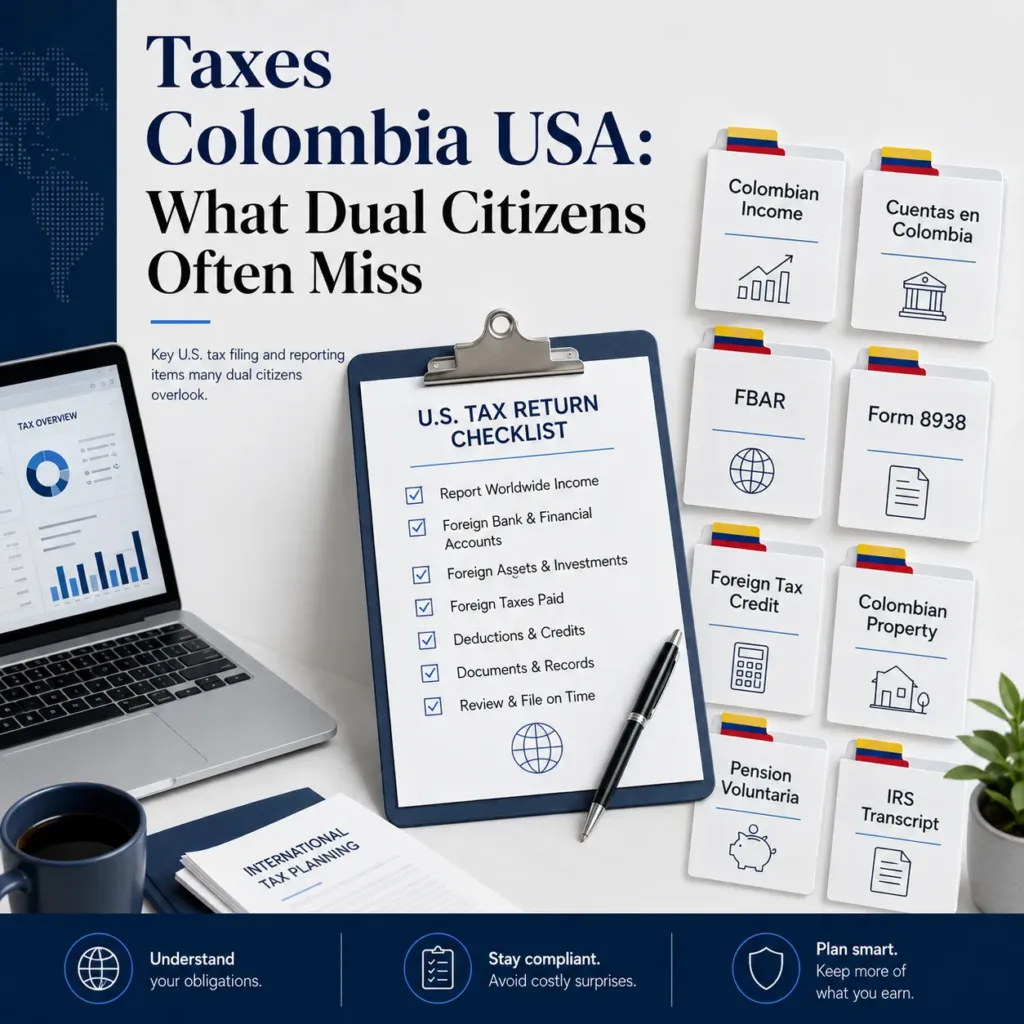
What do dual citizens often miss with taxes Colombia USA?
The answer is usually not one single item. It is a combination of income, accounts, assets, foreign taxes, property, pensions, IRS records, and prior preparer intake questions.
If you already filed and now feel unsure, start with the prior-preparer article here: Me Prepararon Mal Los Taxes? What Colombianos en Miami Should Check First.
Quick Answer:
U.S./Colombia dual citizens often miss that U.S. citizens and resident aliens generally report worldwide income, including Colombian income. They may also miss Colombian bank account reporting, FBAR, Form 8938, Colombian property income, pension voluntaria issues, foreign tax credit treatment, IRS transcript clues, refund risks, and the difference between a basic tax review and a known IRS tax resolution problem.
US Tax on Worldwide Income for U.S./Colombia Dual Citizens
For U.S./Colombia dual citizens, the key tax issue is usually not where the money was earned. The key issue is whether the person is a U.S. citizen, green card holder, or resident alien for U.S. tax purposes.
The IRS says U.S. citizens and resident aliens are subject to tax on worldwide income from all sources and must report taxable income under the Internal Revenue Code. IRS Publication 54 also explains that worldwide income is generally subject to U.S. income tax for U.S. citizens and resident aliens, regardless of where they live.
That means Colombian income may matter even if:
- The money stayed in Colombia
- The income was paid in Colombian pesos
- DIAN already taxed it
- No U.S. Form 1099 was issued
- Your preparer never asked about Colombia
- The income came through a Colombian bank account
If you need the basic income-reporting article, read: Do Colombians in Miami Need to Report Colombian Income on U.S. Taxes?.
Colombian Income Is Not Just Salary
Many dual citizens think “Colombian income” means only a Colombian paycheck. That is too narrow.
Colombian income can include:
- Salary or wages
- Self-employment income
- Professional services income
- Business income
- Rental income
- Airbnb or short-term rental income
- Interest
- Dividends
- Pension distributions
- Property sale gains
- Investment income
- Income through a Colombian entity or family arrangement
Not every item is treated the same way. Not every item creates the same tax result. But the first mistake is ignoring the income completely.
For many taxpayers, the return problem starts because the preparer asked only about U.S. W-2s and 1099s, not ingresos de Colombia.
Paying Tax in Colombia Does Not Automatically Fix the U.S. Side
Another common mistake is assuming, “Ya pagué en Colombia, so I am done.”
Not necessarily.
Paying tax in Colombia may be relevant, but it does not automatically remove the U.S. reporting requirement. The U.S. return may still need to report the income and then evaluate whether a foreign tax credit applies.
The IRS says individuals generally file Form 1116 to claim the foreign tax credit when they paid or accrued certain foreign taxes to a foreign country or U.S. possession. The Form 1116 instructions also explain that the credit applies only to certain foreign taxes and is subject to eligibility and limitation rules.
For dual citizens, this is a big issue because the same Colombian income may raise two questions:
- Was the income reported on the U.S. return?
- Was Colombian tax paid handled correctly?
For the next education step, read: Foreign Tax Credit Mistakes for Colombians Filing U.S. Returns.
Cuentas en Colombia Can Be a Separate Reporting Problem
Dual citizens often miss that Colombian accounts can matter separately from income.
A Colombian account may produce interest, receive rent, hold business funds, or hold personal savings. But even if the account did not produce much income, the account itself may raise reporting questions.
FinCEN says a United States person with a financial interest in, or signature authority over, foreign financial accounts must file an FBAR if the aggregate value of foreign financial accounts exceeds $10,000 at any time during the calendar year.
That can include more than one account. The issue is aggregate value, not just one account or only interest earned.
For more detail, read the completed account article: Cuentas Bancarias Colombianas y Reportes IRS, FBAR, 8938, FATCA.
FBAR and Form 8938 Are Not the Same Thing
FBAR and Form 8938 are frequently confused.
FBAR is filed with FinCEN. Form 8938 is attached to the federal income tax return when the taxpayer has specified foreign financial assets above the applicable reporting threshold.
The IRS says Form 8938 is used to report specified foreign financial assets when the total value is more than the appropriate reporting threshold. The IRS also explains that depending on the taxpayer’s situation, a taxpayer may need FBAR, Form 8938, or both.
Common wrong assumptions include:
- “I filed my U.S. return, so FBAR is done.”
- “I filed FBAR, so Form 8938 is not needed.”
- “I filed Form 8938, so FBAR is not needed.”
- “The account is in Colombia, so the IRS will not care.”
- “The account did not earn income, so there is nothing to report.”
For the deeper education article, use: FBAR vs Form 8938 for Colombian Accounts.
Colombian Property Can Create U.S. Tax Return Issues
Colombian real estate is another area dual citizens often miss.
The issue may involve:
- Rental income
- Airbnb or short-term rental income
- Expenses
- Depreciation
- Colombian property taxes
- Sale proceeds
- Capital gains
- Currency conversion
- Whether the property was held personally or through an entity
A taxpayer may think, “The apartment is in Colombia, so it only belongs on my Colombian return.” But if the taxpayer is a U.S. citizen or resident alien, the U.S. worldwide income rules may still matter.
For a dedicated property article, read: Colombian Property, Rental Income, and U.S. Tax Return Risk.
Pension Voluntaria and Colombian Retirement Accounts Can Be Missed
Many dual citizens do not think of a Colombian pension, pension voluntaria, or retirement-style account as part of U.S. tax return review.
That can be risky.
These accounts may raise questions about:
- Contributions
- Distributions
- Account growth
- Underlying investments
- Foreign tax paid
- FBAR
- Form 8938
- Whether the account resembles a foreign pension or financial asset for U.S. reporting purposes
Do not assume a Colombian pension is automatically treated like a U.S. retirement account. Also do not assume it is irrelevant because no money was withdrawn.
The awareness-level takeaway is simple: if your preparer never asked about pensiones or pension voluntaria, your U.S. return may deserve a second look.
IRS Transcripts May Not Show the Whole Colombia Picture
IRS transcripts can help, but they are not magic.
The IRS says taxpayers can access tax records online or by mail, including transcripts of past tax returns, tax account information, wage and income statements, and verification of non-filing letters.
That can help identify:
- Filing gaps
- Refund activity
- Payments
- Balances
- Penalties
- Wage and income records
- IRS-side mismatch clues
But Colombian income may not appear on a U.S. wage and income transcript if no U.S. payer reported it to the IRS.
So a clean IRS transcript does not automatically mean the return handled Colombia correctly.
For the next education step, read: How IRS Transcripts Can Reveal Refunds, Penalties, and Filing Problems.
The Refund Can Be Too Low or Too High
Dual citizens often focus only on whether the refund was big enough.
But a refund can be wrong in either direction.
A refund that is too low may suggest missed withholding, missed payments, missed credits, or foreign tax credit issues.
A refund that is too high may be a risk if income was omitted, a credit was claimed incorrectly, or foreign forms were missed.
The IRS explains that a CP2000 notice may be issued when income or payment information reported to the IRS does not match the information reported on the tax return.
The goal is not just a bigger refund. The goal is a correct and defensible return.
If this sounds familiar, read: Common U.S. Tax Return Mistakes for Dual U.S./Colombian Taxpayers.
Prior Preparer Intake Matters
For dual citizens, the preparation process matters as much as the final numbers.
A preparer should ask about:
- Colombian income
- Colombian bank accounts
- Foreign financial assets
- Colombian taxes paid
- Colombian rental property
- Colombian property sales
- Colombian pensions
- Business ownership
- FBAR
- Form 8938
- Form 1116 foreign tax credit
- IRS notices
- Prior-year filing gaps
The IRS says anyone paid to prepare federal tax returns must have a valid PTIN, and paid preparers must sign and include their PTIN on returns they prepare. The IRS also advises taxpayers to use a reputable tax professional who signs the return, includes a PTIN, and provides a copy of the return.
If your preparer never asked about Colombia, the issue may not be only math. The issue may be missing facts.
Personal Issue, Business Issue, or Known IRS Problem?
Dual citizens in Miami may also own businesses. That creates another layer.
A personal Form 1040 concern is not the same as a business IRS account concern.
This may be a personal review issue if:
- You are worried about your Form 1040
- You had Colombian income
- You had cuentas en Colombia
- Your refund seems wrong
- You paid foreign tax in Colombia
- You had Colombian pension or property issues
- You want to understand the IRS-side record first
This may be a business review issue if:
- The issue involves an LLC, corporation, S corporation, or partnership
- There are payroll deposits or Form 941 concerns
- There are business penalties
- There are business IRS transcript questions
- There are entity-level filing gaps
This may already be a tax resolution issue if:
- You received an IRS notice
- You owe a balance
- You have penalties
- You have unfiled returns
- You have a lien, levy, audit, or collection problem
- You received a CP2000-style mismatch notice
If the concern is personal and still unclear, Edward Parsons CPA offers a CPA-led Tax Refund & Risk Assessment (Personal), described in the product catalog as an IRS transcript-based review for refund opportunities, penalties, filing issues, and personal tax risks.
If the concern is business-related, the better route may be Tax Refund & Risk Assessment (Business), which is designed around business IRS records, payroll indicators, penalties, filing gaps, and business tax risks.
If there is already an active IRS notice, balance, penalty, lien, levy, audit, or collection issue, a deeper tax resolution case analysis may be more appropriate than a basic review.
The Safer Next Step
If you are a U.S./Colombia dual citizen and something about your return feels off, do not panic and do not assume everything must be amended immediately.
Start by identifying what category may have been missed:
- Colombian income
- Colombian accounts
- FBAR
- Form 8938
- Foreign tax credit
- Colombian property
- Pension voluntaria
- Refund issue
- IRS transcript issue
- Prior preparer issue
- Business versus personal issue
- Known IRS notice or collection problem
Then continue through the cluster:
- Me Prepararon Mal Los Taxes? What Colombianos en Miami Should Check First
- Do Colombians in Miami Need to Report Colombian Income on U.S. Taxes?
- Common U.S. Tax Return Mistakes for Dual U.S./Colombian Taxpayers
- Cuentas Bancarias Colombianas y Reportes IRS, FBAR, 8938, FATCA
- FBAR vs Form 8938 for Colombian Accounts
- Foreign Tax Credit Mistakes for Colombians Filing U.S. Returns
- How IRS Transcripts Can Reveal Refunds, Penalties, and Filing Problems
- CPA Tax Return Review for Colombians in Miami
Tranquilo. The goal is not to blame anyone immediately. The goal is to understand what may have been missed before you ignore the issue, amend too fast, or wait for the IRS to find the problem first.
Taxes Colombia USA: Dual Citizen Questions
These FAQs help U.S./Colombia dual citizens in Miami understand common tax return issues before they amend, ignore the concern, or assume a filed return handled everything correctly.
Do U.S./Colombia dual citizens have to report Colombian income?
In many cases, yes. U.S. citizens and resident aliens generally report worldwide income, including income from Colombia. This can include wages, business income, rent, interest, dividends, pension income, and property sale gains.
For the detailed income article, read Do Colombians in Miami Need to Report Colombian Income on U.S. Taxes? .
Official source: IRS worldwide income guidance
If I paid tax in Colombia, do I still need to report the income in the U.S.?
Paying tax in Colombia does not automatically remove the U.S. reporting requirement. The U.S. return may still need to report the income and then evaluate whether a foreign tax credit applies.
Read Foreign Tax Credit Mistakes for Colombian Taxes Paid for the next education step.
Official source: IRS foreign tax credit guidance
Do cuentas en Colombia matter for dual citizens?
They may. Colombian accounts can raise income reporting questions, FBAR questions, Form 8938 questions, or all three. The account balance, ownership, signature authority, and income activity can matter.
Read Cuentas Bancarias Colombianas y Reportes IRS, FBAR, 8938, FATCA .
Official source: FinCEN FBAR guidance
What do dual citizens often miss about FBAR and Form 8938?
Dual citizens often miss that FBAR and Form 8938 are separate reporting regimes. Filing one does not automatically satisfy the other. Some taxpayers may need one, both, or neither depending on the facts.
Read FBAR vs Form 8938 for Colombian Accounts for a deeper explanation.
Official source: IRS comparison of Form 8938 and FBAR requirements
Can Colombian property create U.S. tax return issues?
Yes. Colombian rental property, Airbnb income, property sale proceeds, expenses, depreciation, Colombian taxes paid, and currency conversion may all need review on a U.S. tax return depending on the facts.
Read Colombian Property, Rental Income, and U.S. Tax Return Risk .
Official source: IRS Publication 54
Does pension voluntaria matter for U.S. taxes?
It can. Colombian pension voluntaria or other retirement-style accounts may raise questions about distributions, account growth, underlying investments, foreign taxes, FBAR, and Form 8938 depending on the facts.
If your preparer never asked about pension accounts, read Me Prepararon Mal Los Taxes? What Colombianos en Miami Should Check First .
Official source: IRS taxation of foreign pension and annuity distributions
Will IRS transcripts show Colombian income or Colombian accounts?
Not always. IRS transcripts can show filing history, refund activity, payments, balances, penalties, and U.S.-reported wage and income data. But Colombian income or accounts may not appear if no U.S. payer reported them to the IRS.
Read How IRS Transcripts Reveal Refunds, Penalties, and Filing Issues to understand the IRS-side record.
Official source: IRS Get Transcript
What if my tax preparer never asked about Colombia?
That is a red flag. It does not automatically prove the return is wrong, but it may mean Colombian income, accounts, foreign taxes, pensions, property, FBAR, or Form 8938 issues were never reviewed.
Start with Common U.S. Tax Return Mistakes for Dual U.S./Colombian Taxpayers .
Official source: IRS choosing a tax professional
Should I amend my return if I missed Colombian income or accounts?
Not automatically. First identify whether the issue is income, FBAR, Form 8938, foreign tax credit, IRS transcript activity, a refund concern, or a known IRS notice. Different issues may require different next steps.
If you are still unsure what the IRS record shows, read How IRS Transcripts Reveal Refunds, Penalties, and Filing Issues .
Official source: IRS amended return guidance
When should a dual citizen use a personal review, business review, or tax resolution analysis?
Use a personal review when the concern is your Form 1040, refund, Colombian income, Colombian accounts, foreign tax credit, property, pension, or personal IRS transcript. Use a business review when the issue involves an LLC, corporation, partnership, payroll, business penalties, or business IRS account. Use tax resolution analysis when there is already an IRS notice, balance, penalty, lien, levy, audit, or collection problem.
Personal route: Tax Refund & Risk Assessment (Personal) . Business route: Tax Refund & Risk Assessment (Business) . Known IRS problem route: Personal CPA Tax Resolution Case Analysis .
Official source: IRS preparer credentials and representation rights