Skip to content
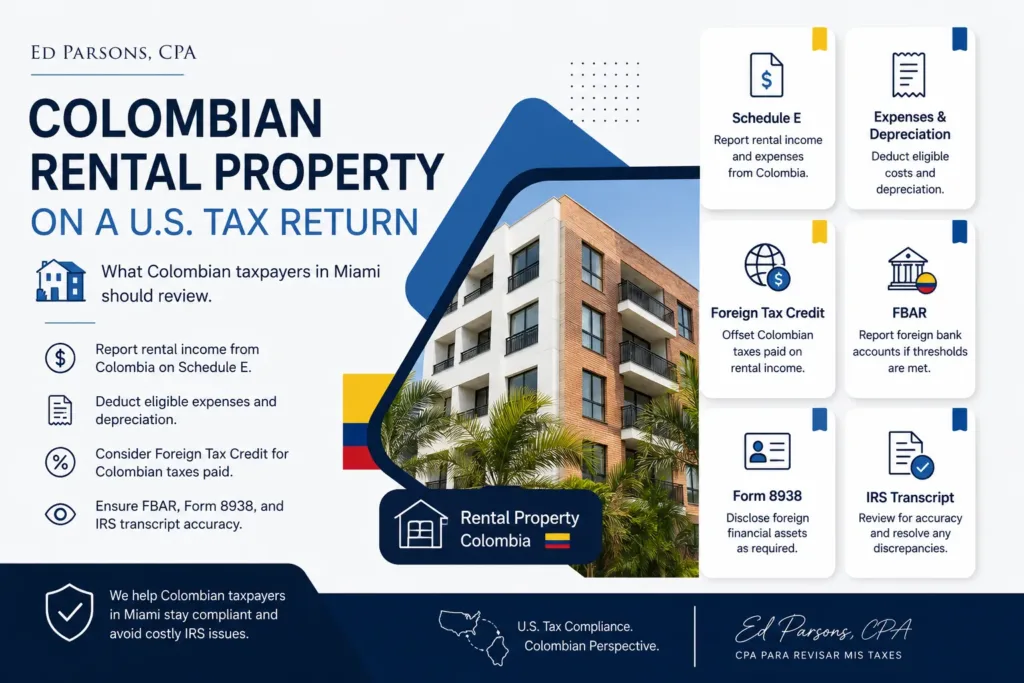
You live in Miami, but you own property in Colombia.
Maybe it is an apartment in Medellín, Bogotá, Cali, Cartagena, Barranquilla, or another Colombian city. Maybe family helps manage it. Maybe tenants deposit rent into a Colombian bank account. Maybe you report something to DIAN. Maybe you paid Colombian property taxes, administration fees, repairs, or withholding.
Then tax season comes in the United States, and the preparer only asks for your W-2s and 1099s.
Now you are wondering:
Did my Colombian rental property need to go on my U.S. tax return?
For many U.S./Colombia dual citizens, green card holders, and Colombian taxpayers in Miami, the answer may be yes. The U.S. return may need to review Colombian rental income, expenses, depreciation, foreign taxes paid, currency conversion, Colombian bank accounts, FBAR, Form 8938, and whether the property was rented, personally used, or sold.
If you are still learning the broader Colombia-side tax issue, start with Taxes Colombia USA: What Dual Citizens Often Miss.
Quick Answer:
Colombian rental property may need to be reported on a U.S. tax return when the taxpayer is a U.S. citizen, green card holder, or U.S. resident alien. The U.S. return may need to report Colombian rental income, deductible expenses, depreciation, foreign taxes paid, currency conversion, and possible Schedule E activity. Colombian bank accounts used for rent may also raise FBAR or Form 8938 questions. Paying tax in Colombia does not automatically mean the U.S. return handled the property correctly.
The First Question: Are You a U.S. Taxpayer With Worldwide Income?
The first issue is not where the property is located. The first issue is your U.S. tax status.
The IRS says U.S. citizens and resident aliens are subject to tax on worldwide income from all sources and must report taxable income according to the Internal Revenue Code. IRS Publication 54 also explains that U.S. citizens and resident aliens generally have worldwide income subject to U.S. income tax, even when income is earned in a foreign country.
That means Colombian rental income may matter even if:
- The property is in Colombia
- Rent was paid in Colombian pesos
- Rent stayed in a Colombian bank account
- A Colombian accountant handled DIAN filings
- Colombian tax was paid
- No U.S. Form 1099 was issued
- Your U.S. preparer never asked about the property
If you need the basic income article, read Do Colombians in Miami Need to Report Colombian Income on U.S. Taxes?.
Colombian Rental Income Is Not Automatically Invisible to the IRS
A Colombian rental property may produce income even if the taxpayer never transfers the money to a U.S. bank.
For U.S. tax purposes, the location of the bank deposit is not the only question. The return may need to review whether rental income was received, whether expenses were paid, and whether the taxpayer had a reportable U.S. tax position.
Common Colombian rental situations include:
- Long-term residential rental
- Short-term rental or Airbnb-style activity
- Family-managed rental property
- Rent deposited into a Colombian bank account
- Property rented part of the year and used personally part of the year
- Property with Colombian taxes, administration fees, repairs, or mortgage interest
- Property rented through a Colombian entity or family arrangement
The details matter. A long-term rental may be different from a short-term rental with substantial services. A personally held apartment may be different from a property held through an entity. A property used by family may require different review from a property rented at market value.
The point is not to panic. The point is to avoid assuming that Colombia-side rental activity is irrelevant.
Where Rental Property Usually Shows Up: Schedule E
For individuals, U.S. rental real estate income and expenses are commonly reported on Schedule E.
The IRS says Schedule E is used to report income or loss from rental real estate, royalties, partnerships, S corporations, estates, trusts, and residual interests. IRS Topic 414 also explains that taxpayers can generally use Schedule E to report income and expenses related to real estate rentals, while substantial services for the tenant’s convenience may point to Schedule C instead.
For Colombian rental property, Schedule E review may involve:
- Gross rent received
- Cleaning, repairs, maintenance, and administration fees
- Property taxes or local charges
- Insurance
- Mortgage interest, if applicable
- Professional fees
- Travel or management costs, if supported
- Depreciation
- Passive activity limitation issues
- Personal-use versus rental-use questions
- Currency conversion into U.S. dollars
This is why a Colombian rental property is not just a “foreign income” issue. It may also be a rental reporting, depreciation, and documentation issue.
If Schedule E preparation is already known to be needed, Edward Parsons CPA offers Schedule E CPA Filing for Rentals, Royalties & K-1 Income, which the product catalog describes as CPA-prepared Schedule E support for rental income, expenses, depreciation coordination, passive loss review, and property-by-property reporting.
Depreciation Is Often Missed
Depreciation is one of the most common mistakes with foreign rental property.
A taxpayer may report rent and expenses but never review depreciation. Another taxpayer may ignore the rental activity completely because the property is outside the United States.
IRS Publication 527 discusses rental income and expenses, including depreciation, and explains how to report residential rental property activity on a return. The IRS also explains that if you rent real estate, you normally report rental income and expenses on Schedule E and list total income, expenses, and depreciation for each rental property.
For Colombian property, depreciation review may require:
- Purchase price and acquisition records
- Land versus building allocation
- Improvements
- Date placed in service as a rental
- Currency conversion
- Prior-year depreciation history
- Whether the property was used personally
- Whether there were suspended losses
This article is not a line-by-line depreciation guide. The education point is that depreciation is not something to guess. If a Colombian rental property was on a U.S. return, the depreciation history may matter for current and future tax years.
Currency Conversion Can Affect the Return
Colombian rental property usually involves Colombian pesos.
U.S. tax returns are reported in U.S. dollars. The IRS foreign currency guidance says that if the U.S. dollar is your functional currency, you generally must translate income, expenses, taxes, and other items received, paid, or accrued in foreign currency into U.S. dollars when they affect the tax computation.
The IRS also says it has no official exchange rate and generally accepts any posted exchange rate used consistently, although the proper rate depends on the taxpayer’s facts and circumstances.
For Colombian rental property, currency conversion may apply to:
- Rent received
- Expenses paid
- Colombian taxes paid
- Improvements
- Purchase documents
- Sale proceeds, if the property is later sold
- Depreciation basis
- Mortgage or debt activity, if applicable
A rough “multiply by whatever rate I found online” approach may create problems if the numbers are large, inconsistent, or unsupported.
Colombian Taxes Paid May Need Form 1116 Review
If you paid Colombian tax on rental income, the U.S. return may need to review foreign tax credit treatment.
Paying tax in Colombia does not automatically remove the U.S. reporting requirement. The U.S. return may still need to report the income and then determine whether a foreign tax credit applies.
The IRS explains that individuals generally file Form 1116 to claim the foreign tax credit when they paid or accrued certain foreign taxes to a foreign country or U.S. possession. IRS Publication 514 also states that unless an exception applies, taxpayers claim the foreign tax credit by filing Form 1116 with the U.S. income tax return.
For Colombian rental property, foreign tax credit mistakes may include:
- Reporting no rental income but trying to use Colombian tax paid
- Reporting rental income but ignoring Colombian tax paid
- Claiming the wrong amount of tax
- Using unsupported exchange rates
- Not separating income categories correctly
- Missing carryovers
- Treating non-creditable payments as creditable tax
For the dedicated article, read Foreign Tax Credit Mistakes for Colombian Taxes Paid.
If Form 1116 is already known to be needed, Edward Parsons CPA offers Form 1116 CPA Foreign Tax Credit Filing, which the catalog describes as CPA-prepared foreign tax credit support for taxpayers with foreign income and foreign taxes paid or accrued, including rental income.
Colombian Rental Bank Accounts: U.S. FBAR & Reporting Issues
Many Colombian rental properties are connected to cuentas en Colombia.
Maybe tenants deposit rent into a Colombian bank account. Maybe the account pays administration fees, repairs, taxes, utilities, or mortgage payments. Maybe sale proceeds eventually go into that account.
That account may create reporting questions separate from the rental income.
FinCEN says a U.S. person with a financial interest in, or signature authority over, foreign financial accounts must file an FBAR when the aggregate value of foreign financial accounts exceeds $10,000 at any time during the calendar year. Form 8938 may also apply when specified foreign financial assets exceed the applicable threshold. The IRS states that Form 8938 is used to report specified foreign financial assets when the total value exceeds the appropriate reporting threshold.
That means Colombian rental property can create both:
- A rental income tax issue
- A foreign account or asset reporting issue
For more detail, read FBAR vs Form 8938 for Colombian Accounts and Colombian Bank and Other Financial Accounts, FBAR, and Form 8938.
Personal Use and Family Use Can Change the Review
Colombian properties are often not purely rental properties.
A taxpayer may rent the apartment for part of the year, use it personally for vacations, let family stay there, or keep it vacant between tenants.
That can affect the U.S. review.
IRS Topic 415 explains that if you receive rental income for the use of a dwelling unit, such as a house or apartment, you may deduct certain expenses, and the rules can vary depending on rental use and personal use.
Questions to review include:
- Was the property rented at fair market value?
- Was the property used by the owner?
- Was it used by family members?
- Was it available for rent all year?
- Were expenses split between personal and rental use?
- Were days of rental use tracked?
- Were repairs and improvements separated?
This is one reason Colombian rental property should not be handled only from memory. Records matter.
Short-Term Rentals May Need Extra Care
A short-term rental in Colombia can be different from a long-term residential rental.
If the property is operated like a regular rental with limited services, Schedule E may still be relevant. If the taxpayer provides substantial services primarily for tenant convenience, the IRS says the activity may belong on Schedule C instead of Schedule E.
This can matter for Airbnb-style rentals, furnished rentals, hotel-like services, cleaning, concierge activity, or other service-heavy arrangements.
The point is not that every short-term rental is automatically Schedule C. The point is that short-term rental facts should be reviewed before assuming the return treatment is obvious.
What If the Property Was Sold?
Selling Colombian property is a separate issue from renting it.
A property sale may involve:
- Sale proceeds in Colombian pesos
- Cost basis
- Improvements
- Depreciation history
- Capital gain or loss
- Colombian taxes paid
- Foreign tax credit review
- Currency conversion
- Installment or timing questions
- Whether the property was personal, rental, or mixed-use
If the property was rented before sale, depreciation history can matter.
This article focuses on rental activity. The next cluster article should be Selling Property in Colombia: U.S. Tax Return Issues to Review.
Can IRS Transcripts Show Colombian Rental Property?
Usually, not completely.
IRS transcripts can help show U.S.-side filing history, refund activity, payments, balances, penalties, and wage and income information. The IRS Get Transcript page explains that taxpayers can access tax return transcripts, tax account transcripts, wage and income transcripts, and verification of non-filing letters.
But Colombian rental income may not appear on a U.S. wage and income transcript if no U.S. payer reported it.
That means a clean IRS transcript does not automatically mean Colombian rental property was handled correctly.
The transcript is one layer. Colombian rental records, bank records, tax records, lease records, and property documents are another layer.
For the transcript article, read How IRS Transcripts Can Reveal Refunds, Penalties, and Filing Problems.
Common Mistakes With Colombian Rental Property
Here are the mistakes that most often deserve review:
- The property was never mentioned to the U.S. preparer.
- Rental income was not reported because it stayed in Colombia.
- Colombian taxes paid were ignored.
- Form 1116 was not considered.
- Expenses were not documented.
- Depreciation was omitted or guessed.
- Personal use was not tracked.
- Airbnb or short-term rental treatment was assumed without review.
- Colombian bank accounts were not reviewed for FBAR or Form 8938.
- Sale of the property was treated as a Colombia-only issue.
- IRS transcripts were treated as proof that Colombia facts did not matter.
If you are worried your preparer missed Colombia-side facts, read Me Prepararon Mal Los Taxes? What Colombianos en Miami Should Check First.
Review, Schedule E Filing, Foreign Tax Credit, or Tax Resolution?
The right route depends on what you already know.
| Situation | Better next step |
|---|---|
| You are unsure whether the Colombian rental was reported correctly | Personal tax review |
| You know Schedule E rental reporting is needed | Schedule E filing support |
| You paid Colombian tax on rental income | Form 1116 foreign tax credit review |
| Rental income went through Colombian bank accounts | FBAR/Form 8938 review |
| Multiple years of foreign income or FBARs may be missing | Streamlined eligibility review may be relevant |
| You already received an IRS notice, balance, penalty, audit, lien, or levy | Tax resolution analysis |
Edward Parsons CPA offers a CPA-led Tax Refund & Risk Assessment (Personal) for personal return concerns involving potential missed refunds, IRS account issues, filing gaps, income mismatch indicators, and tax risks based on IRS transcript history.
If you already know rental reporting is needed, Schedule E CPA Filing for Rentals, Royalties & K-1 Income may fit. If the issue is foreign tax credit treatment, Form 1116 CPA Foreign Tax Credit Filing may fit.
If multiple years of foreign income, accounts, FBARs, or foreign forms may be missing, IRS Streamlined Filing Compliance Package By CPA may be relevant only if the facts fit.
If you already have an IRS notice, penalty, balance, lien, levy, audit, or collection issue, the better route may be Personal CPA Tax Resolution Case Analysis.
Colombian Rental Bank Accounts: U.S. FBAR & Reporting Issues
If you owned rental property in Colombia, do not assume it was handled just because your U.S. return was accepted.
Start by checking:
- Was the rental income reported?
- Were expenses documented?
- Was depreciation considered?
- Was the property personally used?
- Were Colombian taxes paid?
- Was Form 1116 reviewed?
- Were Colombian pesos converted to U.S. dollars consistently?
- Did rent flow through Colombian bank accounts?
- Were FBAR and Form 8938 considered?
- Was the property sold during or after the rental period?
- Do IRS transcripts show refund, penalty, balance, or mismatch clues?
Then continue through the cluster:
- Foreign Tax Credit Mistakes for Colombian Taxes Paid
- Do Colombians in Miami Need to Report Colombian Income on U.S. Taxes?
- FBAR vs Form 8938 for Colombian Accounts
- Colombian Bank and Other Financial Accounts, FBAR, and Form 8938
- Taxes Colombia USA: What Dual Citizens Often Miss
- Common U.S. Tax Return Mistakes for Dual U.S./Colombian Taxpayers
- How IRS Transcripts Can Reveal Refunds, Penalties, and Filing Problems
- Selling Property in Colombia: U.S. Tax Return Issues to Review
- CPA Tax Return Review for Colombians in Miami
Tranquilo. The goal is not to panic. The goal is to understand whether the Colombian rental property was reported correctly, whether foreign taxes and accounts were reviewed, and whether this is a return review, form filing, streamlined filing, or tax resolution issue.
Colombian Rental Property on a U.S. Tax Return: Common Questions
These FAQs help Colombian taxpayers in Miami understand when Colombian rental property may raise U.S. tax return, Schedule E, foreign tax credit, FBAR, Form 8938, transcript, or CPA review questions.
Do I have to report Colombian rental property on a U.S. tax return?
If you are a U.S. citizen, green card holder, or U.S. resident alien, Colombian rental income may need to be reported because U.S. taxpayers generally report worldwide income.
For the broader income rule, read Do Colombians in Miami Need to Report Colombian Income on U.S. Taxes? .
Official source: IRS worldwide income guidance
Where does rental property usually go on a U.S. tax return?
Rental real estate income and expenses are commonly reported on Schedule E for individual taxpayers, unless the facts point to a different treatment, such as substantial services that may require Schedule C review.
If Schedule E filing is already needed, review Schedule E CPA Filing for Rentals, Royalties & K-1 Income .
Official source: IRS Topic 414, Rental Income and Expenses
Does Colombian rental income matter if the money stayed in Colombia?
Yes, it may. For U.S. tax purposes, the fact that rent stayed in a Colombian bank account does not automatically remove the reporting question. The income, expenses, taxes paid, and account reporting issues may still need review.
If rent moved through Colombian accounts, also read FBAR vs Form 8938 for Colombian Accounts .
Official source: IRS Publication 54
Can I deduct Colombian rental property expenses?
Certain rental expenses may be deductible depending on the facts, records, rental use, personal use, and U.S. tax rules. Common review areas include repairs, maintenance, administration fees, insurance, mortgage interest, taxes, and depreciation.
If the property was rented and later sold, read the next article: Selling Property in Colombia: U.S. Tax Return Issues to Review .
Official source: IRS Publication 527, Residential Rental Property
Does depreciation apply to Colombian rental property?
Depreciation may need to be reviewed when Colombian property is used as a rental. The review may involve purchase records, land versus building value, improvements, placed-in-service date, prior depreciation, and currency conversion.
If your preparer never asked about depreciation, read Common U.S. Tax Return Mistakes for Dual U.S./Colombian Taxpayers .
Official source: IRS rental real estate income, deductions, and recordkeeping
Do Colombian pesos need to be converted to U.S. dollars?
Yes. U.S. tax returns are reported in U.S. dollars. Colombian rental income, expenses, taxes paid, improvements, and other relevant amounts generally need to be translated into U.S. dollars using a supportable exchange rate method.
If Colombian taxes paid are part of the issue, read Foreign Tax Credit Mistakes for Colombian Taxes Paid .
Official source: IRS foreign currency and exchange rate guidance
Can Colombian taxes paid on rental income reduce U.S. tax?
Possibly. Colombian taxes paid on rental income may require foreign tax credit review, usually through Form 1116 for individuals. But the credit is not automatic, and the income generally still needs to be reported.
If Form 1116 preparation is already needed, review Form 1116 CPA Foreign Tax Credit Filing .
Official source: IRS foreign tax credit guidance
Can a Colombian rental property create FBAR or Form 8938 issues?
The property itself is not the same thing as a bank account, but Colombian accounts used to receive rent or pay property expenses may raise FBAR or Form 8938 questions depending on values, ownership, and account type.
Read Colombian Bank and Other Financial Accounts, FBAR, and Form 8938 .
Official source: IRS foreign bank and financial account reporting guidance
Can IRS transcripts show Colombian rental income?
Not usually if no U.S. payer reported the income to the IRS. Transcripts can help show IRS-side filing history, refunds, payments, balances, penalties, and some income records, but they do not replace Colombian rental records.
For the IRS-side record, read How IRS Transcripts Can Reveal Refunds, Penalties, and Filing Problems .
Official source: IRS Get Transcript
When should I use a review, Schedule E filing, Form 1116 filing, streamlined filing, or tax resolution analysis?
Use a review when you are unsure whether the Colombian rental property was handled correctly. Use Schedule E filing when rental reporting is needed. Use Form 1116 filing when Colombian taxes paid need foreign tax credit analysis. Consider streamlined filing only when multiple years of foreign income, accounts, FBARs, or returns may be missing and the facts fit. Use tax resolution analysis when there is already an IRS notice, balance, penalty, lien, levy, audit, or collection problem.
Personal review: Tax Refund & Risk Assessment (Personal) . Schedule E filing: Schedule E CPA Filing . Streamlined filing: IRS Streamlined Filing Compliance Package By CPA . Known IRS problem: Personal CPA Tax Resolution Case Analysis .
Official source: IRS choosing a tax professional