Skip to content
You sold property in Colombia, or you are about to sell.
Maybe it was an apartment in Medellín, Bogotá, Cali, Cartagena, Barranquilla, or another Colombian city. Maybe it was inherited. Maybe it used to be your home. Maybe it was rented for years. Maybe the proceeds stayed in Colombia. Maybe Colombian tax was paid at closing or through DIAN.
Now you are asking the question that matters for U.S. tax purposes:
Does selling property in Colombia need to be reported on my U.S. tax return?
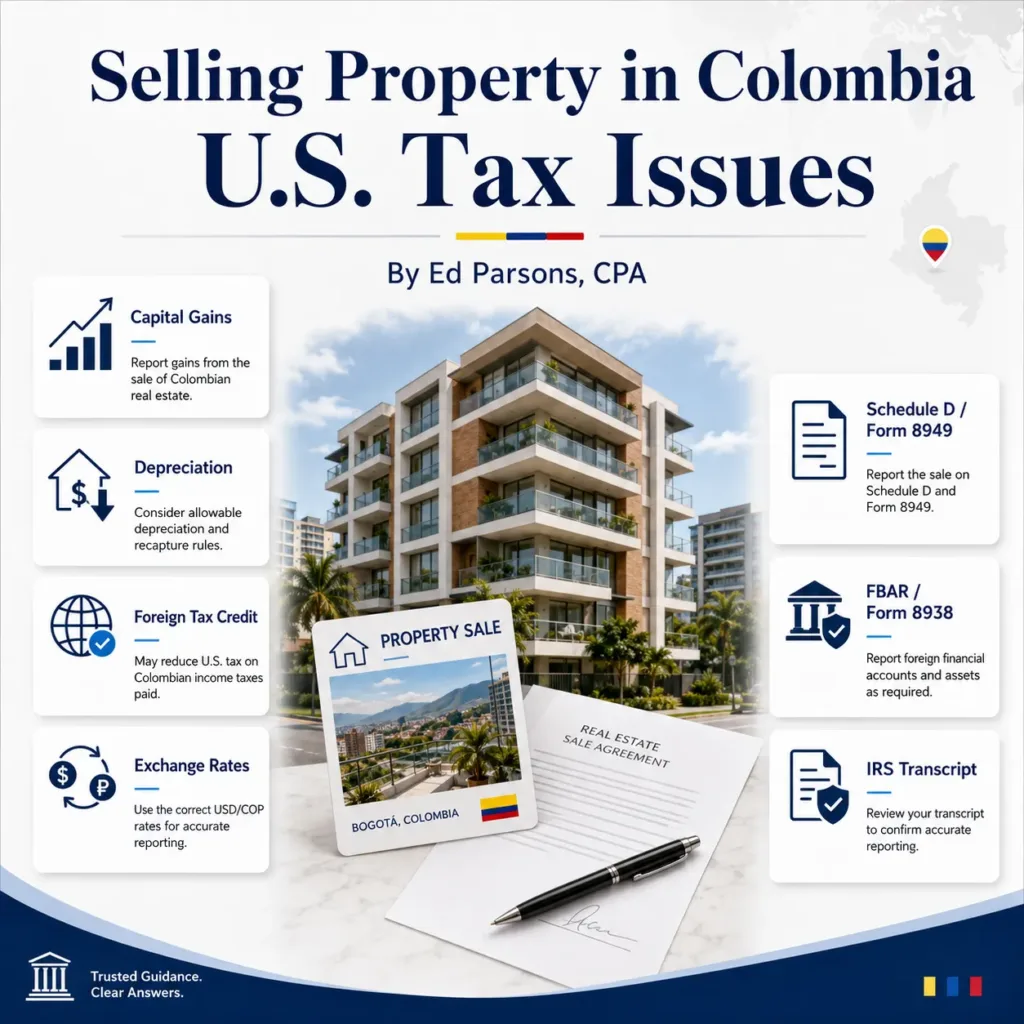
For U.S./Colombia dual citizens, green card holders, and Colombian taxpayers in Miami who are U.S. tax residents, the answer may be yes. The U.S. tax issue can involve capital gains, basis, improvements, depreciation history, foreign taxes paid, Form 1116, exchange rates, Colombian bank accounts, FBAR, Form 8938, IRS transcripts, and whether the property was personal, rental, business, or mixed-use.
If this property was rented before sale, start with the related article: Colombian Property, Rental Income, and U.S. Tax Return Risk.
Quick Answer:
Selling property in Colombia may need to be reported on a U.S. tax return if the seller is a U.S. citizen, green card holder, or U.S. resident alien. The U.S. return may need to review capital gain or loss, cost basis, improvements, depreciation, Colombian taxes paid, foreign tax credit, Form 8949, Schedule D, exchange rates, and whether sale proceeds moved through Colombian accounts that raise FBAR or Form 8938 questions.
Why a Colombian Property Sale Can Matter on a U.S. Return
For many taxpayers, the first mistake is thinking:
“La propiedad está en Colombia, so it is only a Colombian tax issue.”
That assumption can be risky.
The IRS says U.S. citizens and resident aliens generally are subject to U.S. tax on worldwide income. That can include gain from property located outside the United States. The property location matters, but it does not automatically remove the U.S. reporting question.
If you are still learning the worldwide income rule, read Do Colombians in Miami Need to Report Colombian Income on U.S. Taxes?.
A Colombian property sale may need U.S. review even if:
- The sale closed in Colombia
- The sale proceeds stayed in Colombia
- The buyer paid in Colombian pesos
- Colombian tax was withheld or paid
- A Colombian accountant handled the local filing
- No U.S. Form 1099 was issued
- Your U.S. preparer never asked about the sale
The correct question is not only “Did Colombia tax it?” The better question is “Was the U.S. return required to report it, and if yes, was it reported correctly?”
Personal Home, Rental Property, or Investment Property?
Before a CPA can evaluate the tax issue, the property has to be classified.
A Colombian property sale may involve:
- A personal residence
- A vacation home
- A rental property
- A former rental converted to personal use
- A personal property later converted to rental use
- An inherited property
- Property held through an entity
- Property used partly by family and partly by tenants
- Property connected to a Colombian business
That classification matters because the U.S. return may treat the sale differently depending on the facts.
IRS Publication 544 explains that property held for personal use is generally a capital asset, gain from its sale is generally capital gain, and loss from the sale of personal-use property is generally not deductible. It also notes that gains and losses from sales of capital assets are generally reported on Form 8949 and Schedule D. (irs.gov)
If the property was a rental, depreciation history may matter. If it was your principal residence, home-sale exclusion rules may need review. If it was held through an entity, the issue may be more complex than a normal individual Form 1040 capital gain.
Was It Your Home?
If the property was your home, the U.S. return may need to review whether any home-sale exclusion applies.
IRS Publication 523 explains that if you sell your home and have gain that cannot be excluded, you generally report the gain on Form 8949 and Schedule D. It also discusses the ownership and use tests for the exclusion. (irs.gov)
This does not mean every Colombian home sale qualifies for the exclusion. It also does not mean every gain is taxable. The point is that the facts matter.
Questions to review include:
- Did you own the property?
- Did you use it as your main home?
- How long did you own and use it?
- Was it rented during part of the ownership period?
- Was it used by family?
- Was any part used for business?
- Was depreciation ever claimed?
- Did you sell another home recently?
- Was there Colombian tax paid?
For a Colombia-connected taxpayer, the home-sale question also connects with currency conversion, Colombian documentation, and whether the sale proceeds entered Colombian financial accounts.
Was It a Rental Property?
If the Colombian property was rented, the sale review is more complex.
The return may need to consider:
- Rental income history
- Expenses
- Depreciation claimed or allowable
- Land versus building allocation
- Improvements
- Prior-year Schedule E reporting
- Passive loss issues
- Sale price
- Selling costs
- Colombian tax paid
- Currency conversion
- Possible depreciation recapture
- Capital gain or loss reporting
IRS Publication 544 explains that part of the gain on the sale of depreciable property may have to be recaptured as ordinary income on Form 4797. This is a major reason a rental property sale should not be treated like a simple personal asset sale. (irs.gov)
If the property was rented and the prior U.S. returns did not report the rental activity, the issue may become a review or amendment question, not just a current-year sale question.
Related cluster article: Colombian Property, Rental Income, and U.S. Tax Return Risk.
Basis Is Usually the Heart of the Sale Review
For a property sale, the gain is not simply the sale price.
A CPA review may need to evaluate:
- Original purchase price
- Purchase date
- Closing costs
- Improvements
- Land versus building allocation
- Depreciation history
- Sale price
- Selling costs
- Colombian taxes connected to the sale
- Exchange rates
- Prior use of the property
- Personal versus rental use
- Inheritance or gift basis issues, if applicable
This is where many mistakes happen.
A taxpayer may only provide the closing statement from Colombia, but the U.S. return may also need purchase documents, improvement records, depreciation schedules, rental history, prior returns, foreign tax records, and exchange rate support.
The goal is not just to calculate a number. The goal is to calculate a number that can be explained and defended.
Currency Conversion Can Change the Result
Colombian property transactions usually involve Colombian pesos.
U.S. tax returns are filed in U.S. dollars. The IRS foreign currency guidance says taxpayers whose functional currency is the U.S. dollar generally must translate foreign-currency income, expenses, taxes, and other items into U.S. dollars when those items affect tax computation. The IRS also says to use the exchange rate prevailing when the item is received, paid, or accrued, or another rate that properly reflects income if more than one exchange rate exists. (irs.gov)
For a Colombian property sale, currency conversion may affect:
- Purchase price
- Improvements
- Depreciation basis
- Rental income and expenses
- Sale proceeds
- Selling costs
- Colombian taxes paid
- Mortgage or debt activity, if any
A rough conversion can distort the gain. This is especially true when the property was bought years ago and sold later after major exchange rate changes.
Colombian Taxes Paid Do Not Automatically Solve the U.S. Issue
Colombian tax paid on the sale may be relevant, but it does not automatically finish the U.S. tax analysis.
The IRS foreign tax credit rules generally allow a credit only for certain foreign taxes imposed by a foreign country or U.S. possession, and generally only income, war profits, and excess profits taxes qualify. (irs.gov)
IRS Publication 514 explains how to choose between a credit and deduction, who can take the credit, what foreign taxes qualify, how to figure the credit, and how to carry unused foreign taxes to other tax years. (irs.gov)
For Colombian property sales, common foreign tax credit mistakes include:
- Assuming every Colombian closing payment is creditable tax
- Claiming a credit without reporting the gain correctly
- Using the wrong exchange rate for Colombian tax paid
- Missing Form 1116
- Using the wrong foreign income category
- Missing carryovers
- Not matching the tax to the income
For the dedicated article, read Foreign Tax Credit Mistakes for Colombian Taxes Paid.
If Form 1116 is already known to be needed, Edward Parsons CPA offers Form 1116 CPA Foreign Tax Credit Filing, which is a CPA-prepared service for foreign income and foreign taxes paid or accrued, including capital gains and currency conversion coordination.
Colombian Bank Accounts Can Become Part of the Sale Issue
A Colombian property sale often moves through Colombian bank accounts.
That may raise a separate reporting issue.
If sale proceeds were deposited into cuentas en Colombia, the account value may trigger FBAR or Form 8938 questions. FinCEN’s FBAR rule focuses on aggregate foreign financial account value, while Form 8938 focuses on specified foreign financial assets above applicable thresholds.
That means the sale can create multiple layers:
- Capital gain reporting
- Foreign tax credit review
- Currency conversion
- Colombian account reporting
- IRS transcript review
- Prior-year rental review
For bank account reporting, read FBAR vs Form 8938 for Colombian Accounts and Colombian Bank and Other Financial Accounts, FBAR, and Form 8938.
What If the Property Was Inherited?
Inherited Colombian property may need separate review.
The U.S. return may need to consider:
- Date of death value
- Colombian inheritance documents
- Whether the taxpayer became owner before sale
- Basis rules
- Sale proceeds
- Colombian taxes paid
- Currency conversion
- Whether income was earned before sale
- Whether proceeds entered foreign accounts
This article does not give a full inheritance basis guide because the facts can vary. The trust-stage point is that inherited property should not be treated casually. The documents and timing matter.
If the property was inherited and later rented or sold, the review may need both property-sale analysis and rental-history analysis.
What If the Property Was Held Through a Colombian Entity?
If the property was held through a Colombian company, partnership, trust, or other entity, the U.S. issue may be much more complex than a simple property sale.
The review may involve:
- Who owned the entity
- Whether the entity itself had U.S. reporting obligations
- Whether Forms 5471, 8865, 8858, 3520, or other international forms are relevant
- Whether income was reported correctly
- Whether sale proceeds belonged to the entity or the individual
- Whether distributions occurred
- Whether Form 8938 or FBAR also applies
This is where a basic property-sale article is not enough. If the sale involves a Colombian entity, custom CPA analysis may be needed before choosing a form package or filing route.
Edward Parsons CPA’s Hourly CPA Services for Work Outside Fixed Form Packages (current hourly rate shown on the service page) may be relevant when the situation requires custom tax planning, analysis, return review, or work outside a fixed-scope form package.
Can IRS Transcripts Show a Colombian Property Sale?
Usually, not completely.
IRS transcripts can help show U.S.-side activity such as filed returns, account balances, penalties, payments, refunds, and some income records. But a Colombian property sale may not appear on an IRS wage and income transcript if no U.S. payer reported it.
That means a clean transcript does not prove the Colombian sale was handled correctly.
A CPA review should usually compare:
- The filed U.S. return
- Prior returns
- IRS transcripts
- Colombian sale documents
- Purchase documents
- Improvement records
- Rental history
- Colombian tax records
- Bank account records
- Foreign account reporting history
If your concern is the IRS-side record, read How IRS Transcripts Can Reveal Refunds, Penalties, and Filing Problems.
Why This Is a Trust Issue, Not Just a Tax Form Issue
Selling Colombian property is not only about entering a sale price into software.
A good CPA review asks:
- Was the property personal, rental, mixed-use, inherited, or entity-owned?
- Was Colombian rental income reported in prior years?
- Was depreciation claimed or allowable?
- What documents support basis?
- What exchange rates were used?
- Were Colombian taxes paid and do they qualify for credit review?
- Did sale proceeds trigger foreign account reporting?
- Do IRS transcripts show prior-year issues?
- Is this a review, amendment, form filing, streamlined filing, or tax resolution matter?
That matters because the wrong path can create more problems.
If the return has not yet been filed, the issue may be proper reporting. If the return was already filed and Colombia facts were omitted, the issue may be review or amendment analysis. If there is already an IRS notice, penalty, balance, audit, lien, or levy, the issue may be tax resolution.
Review, Form Filing, Custom Analysis, or Tax Resolution?
Use this routing framework:
| Situation | Better next step |
|---|---|
| You sold Colombian property and are unsure how it affects your U.S. return | CPA review |
| The sale was already filed, but you suspect it was reported wrong | Tax refund and risk review |
| Colombian tax was paid on the sale | Form 1116 foreign tax credit review |
| Sale proceeds went through Colombian bank accounts | FBAR/Form 8938 review |
| The property was rented before sale | Schedule E and depreciation history review |
| The property was held through a Colombian entity | Custom CPA analysis |
| Multiple years of foreign income, accounts, or FBARs may be missing | Streamlined eligibility review may be relevant |
| You already have an IRS notice, balance, penalty, lien, levy, or audit | Tax resolution case analysis |
Edward Parsons CPA offers a CPA-led Tax Refund & Risk Assessment (Personal) for personal return concerns involving possible missed refunds, penalties, IRS account issues, filing gaps, income mismatch indicators, and personal tax risks based on IRS transcript history.
If the property sale created a foreign tax credit issue, Form 1116 CPA Foreign Tax Credit Filing may be relevant. If the issue involves a business, entity, payroll, or business IRS account, Tax Refund & Risk Assessment (Business) may be the better route.
If there is already an IRS notice, penalty, balance, lien, levy, audit, or collection issue, a deeper tax resolution case analysis may be more appropriate than a basic review.
Why Work With a CPA on a Colombian Property Sale?
A Colombian property sale can combine U.S. tax, Colombian documents, foreign currency, rental history, capital gains, foreign tax credit, depreciation, foreign account reporting, and IRS transcript review.
That is not the same as a basic W-2 return.
A CPA-led review can help organize the issue into the right category:
- Reportable gain or loss
- Home-sale exclusion review
- Rental property sale review
- Depreciation history issue
- Form 1116 foreign tax credit issue
- FBAR or Form 8938 issue
- Prior-year amendment issue
- Streamlined filing issue
- Tax resolution issue
The point is not to scare you. The point is to avoid guessing.
Tranquilo. Before you assume the sale is fine, before you amend too fast, and before you wait for an IRS letter, first understand what category the Colombian property sale belongs in.
The Safer Next Step
If you sold property in Colombia, gather the facts before choosing the filing path.
Start with:
- Purchase documents
- Sale documents
- Closing statements
- Colombian tax payment records
- Improvement records
- Rental history
- Prior U.S. returns
- Depreciation schedules
- Colombian bank records
- Exchange rate support
- IRS transcripts
- Entity documents, if applicable
Then continue through the cluster:
- Colombian Property, Rental Income, and U.S. Tax Return Risk
- Foreign Tax Credit Mistakes for Colombian Taxes Paid
- Do Colombians in Miami Need to Report Colombian Income on U.S. Taxes?
- FBAR vs Form 8938 for Colombian Accounts
- Colombian Bank and Other Financial Accounts, FBAR, and Form 8938
- How IRS Transcripts Can Reveal Refunds, Penalties, and Filing Problems
- CPA Tax Return Review for Colombians in Miami
If your situation is still unclear and the sale belongs on your personal return, the CPA-led Tax Refund & Risk Assessment (Personal) may help identify whether the filed return, IRS transcript history, refund indicators, penalty activity, or amendment indicators deserve deeper review.
Selling Property in Colombia: Common U.S. Tax Questions
These FAQs help U.S./Colombia taxpayers in Miami understand when a Colombian property sale may raise capital gains, foreign tax credit, depreciation, account reporting, IRS transcript, or CPA review issues.
Do I have to report the sale of property in Colombia on my U.S. tax return?
If you are a U.S. citizen, green card holder, or U.S. resident alien, the sale may need U.S. tax review because U.S. taxpayers generally report worldwide income. The sale may involve capital gain, basis, foreign taxes paid, exchange rates, and account reporting.
For the broader income rule, read Do Colombians in Miami Need to Report Colombian Income on U.S. Taxes? .
Official source: IRS worldwide income guidance
Where is a Colombian property sale reported on a U.S. return?
A personal or investment property sale may be reported on Form 8949 and Schedule D when there is reportable capital gain or loss. A rental property sale may also require depreciation and possible Form 4797 review depending on the facts.
If the property was rented before sale, read Colombian Property, Rental Income, and U.S. Tax Return Risk .
Official source: IRS Publication 544, Sales and Other Dispositions of Assets
Can the U.S. home sale exclusion apply to a Colombian home?
It may, depending on the ownership and use facts. The property location alone does not answer the question. A review should consider whether the taxpayer owned and used the property as a main home, whether it was rented, and whether any gain cannot be excluded.
If a gain cannot be excluded, IRS Publication 523 explains that it is generally reported on Form 8949 and Schedule D.
Official source: IRS Publication 523, Selling Your Home
Do Colombian pesos need to be converted to U.S. dollars?
Yes. U.S. tax returns are reported in U.S. dollars. Purchase price, improvements, depreciation basis, sale proceeds, selling costs, and Colombian taxes paid may all require currency conversion.
If currency conversion connects to Colombian taxes paid, read Foreign Tax Credit Mistakes for Colombian Taxes Paid .
Official source: IRS foreign currency and exchange rate guidance
Can Colombian tax paid on the sale reduce U.S. tax?
Possibly. Colombian income tax paid on the sale may need foreign tax credit review, often through Form 1116 for individuals. But the credit is not automatic, and not every Colombian payment qualifies.
If Form 1116 preparation is already needed, review Form 1116 CPA Foreign Tax Credit Filing .
Official source: IRS foreign tax credit guidance
What if the Colombian property was rented before I sold it?
Rental history can affect the review. The sale may involve prior Schedule E reporting, depreciation claimed or allowable, passive loss issues, foreign taxes paid, and possible depreciation recapture.
Start with Colombian Property, Rental Income, and U.S. Tax Return Risk .
Official source: IRS Publication 544
Can sale proceeds in a Colombian bank account create FBAR or Form 8938 issues?
Yes, they can. If sale proceeds were deposited into Colombian bank or financial accounts, the account value may raise FBAR or Form 8938 questions depending on ownership, signature authority, maximum value, and asset type.
Read FBAR vs Form 8938 for Colombian Accounts .
Official source: FinCEN FBAR guidance
Can IRS transcripts show a Colombian property sale?
Usually not completely. IRS transcripts can help show filing history, refunds, payments, penalties, balances, and some U.S.-reported income records, but they may not show a Colombian property sale if no U.S. payer reported it.
For the IRS-side record, read How IRS Transcripts Can Reveal Refunds, Penalties, and Filing Problems .
Official source: IRS Get Transcript
Should I amend my return if I forgot to report a Colombian property sale?
Not automatically without review. First determine what was missed, whether there was gain, whether Colombian tax was paid, whether foreign account reporting applies, and whether IRS transcripts show related activity.
If you are still unsure, start with Me Prepararon Mal Los Taxes? What Colombianos en Miami Should Check First .
Official source: IRS amended return guidance
When should I use a CPA review, Form 1116 filing, custom analysis, or tax resolution?
Use a CPA review when you are unsure whether the Colombian sale was handled correctly. Use Form 1116 filing when the foreign tax credit form is clearly needed. Use custom CPA analysis when the property was inherited, entity-owned, mixed-use, or complex. Use tax resolution analysis when there is already an IRS notice, penalty, balance, audit, lien, levy, or collection problem.
Personal review: Tax Refund & Risk Assessment (Personal) . Form 1116: Form 1116 CPA Foreign Tax Credit Filing . Custom analysis: Hourly CPA Services for Work Outside Fixed Form Packages . Known IRS problem: Personal CPA Tax Resolution Case Analysis .
Official source: IRS choosing a tax professional