Skip to content
By Edward Parsons, CPA · licensed since 2009
Key takeaways
- TaxAct does carry Form 8621, in its Deluxe, Premier and Self-Employed editions according to its own forms lists, but not in Free or desktop Basic. Its help pages describe a fillable form, with up to 50 per return before the return has to be filed on paper.
- A fillable form means you type the figures. TaxAct’s help pages don’t describe working out the Part V figures from your purchase and sale history, and that calculation is the hard part of the form.
- Whatever you type flows on. TaxAct’s own help pages explain how Form 8621 entries flow to Form 1040, and warn that the program can’t tell which fund income you already reported from your 1099. A figure typed in wrong becomes tax reported wrong.
- One fund can need many Part V entries. The IRS instructions call for a separate Part V for each block of shares with its own holding period, and every reinvested dividend or monthly purchase starts a new block.
- A checkbox in Part II is an election in law. A QEF or mark-to-market election applies to every later year and can be revoked only with IRS consent.
- Do the calculation first, with a tool built for it, such as the PFIC Calculator & Form 8621 Generator, and only then decide what goes into any program’s boxes.
People who leave TurboTax over Form 8621 often land on TaxAct, because TaxAct has the form. That part is true, and it is a real difference. It is also where a different problem starts. When the form is missing, you know you have a gap. When the form is there, it is easy to believe the hard part is handled.
This guide explains what TaxAct’s Form 8621 does and doesn’t do, the three places it most often goes wrong, and what to do before you type anything into it.
Does TaxAct support Form 8621?
Yes, as a form. TaxAct’s help article on the Form 8621 fillable form says you add it to your return through the Forms Assistant online, or the Forms Explorer in the desktop program. A second TaxAct article says the program supports entry of up to 50 Forms 8621 per return, and that a return needing more than 50 has to be filed on paper.
Which edition you buy matters. TaxAct’s published lists of supported federal forms show Form 8621 in its Deluxe, Premier and Self-Employed editions, online and desktop. Its Free edition and its desktop Basic edition don’t list it, and the Free edition names foreign accounts among the situations it doesn’t cover. The lists are described as a select list, so check inside the program for the year you are filing.
That makes TaxAct different from TurboTax, which doesn’t include Form 8621 at all. My guide to what to do when TurboTax doesn’t do Form 8621 covers that side. For every program side by side, see which tax software supports Form 8621.
What the TaxAct pages don’t describe is the calculation. They explain how to add the form and how to handle a large number of them. They say nothing about working out Part V from your transactions.
What does “fillable form” mean for Form 8621?
It means the boxes are there and the numbers are yours.
For most forms that is fine, because the numbers come from a document someone sends you. Part V of Form 8621 is different. For a fund taxed under the default rules of section 1291, the figures you would type are the end of a long calculation:
- the distributions for each block of shares, and what that block received in the three prior years;
- the 125% threshold, and the excess above it;
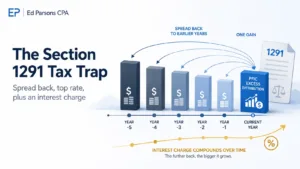
- the excess spread across every day of the holding period, year by year;
- the tax on each prior year’s share at that year’s top rate;
- interest on each of those amounts, compounded daily at a rate that changes every quarter, under section 6621.
The Form 8621 instructions also say the allocation behind lines 16a and 16b is worked “on a separate sheet” and attached to the form. A box on a screen is not that sheet.
So a fillable Form 8621 is the last step of the job, not the job. Before you can fill it in, someone has to have done the calculation.
Why does what I type matter so much?
Because TaxAct carries it to the rest of your return.
TaxAct’s own help page for returns with more than 50 Forms 8621 is built around exactly this. It walks through grouping the forms by the election in Part II, entering them in batches, printing and deleting, and entering combined totals so the information flows through to Form 1040. It also warns about accidental doubling of amounts.
That procedure shows two things. Form 8621 entries are not a side document in TaxAct: they drive the tax on your return. And the program takes the figures as given. If a Part V figure is wrong, the error doesn’t stay on Form 8621. It becomes part of the tax you report.
The Part V results land in more than one place. Part of a distribution is reported as a dividend, the deferred tax is added to the tax itself, and the interest goes on a separate line. Each of those has to match the calculation, and none of them checks it.
Will TaxAct know what I already reported from my 1099?
No, and its own help page says so.
Your broker’s 1099 may already have put the fund’s dividends into your return as ordinary dividends. Form 8621 reports some of the same money again, as a nonexcess distribution on line 15e or a first-year distribution on line 15a. TaxAct’s help article on Form 8621 dividend income explains that its form has extra entry lines next to lines 15a and 15e for amounts not already counted, because the program “cannot be certain what income has already been reported on Form 1040.”
So the decision about what is already in your return is yours. Count it twice and you overstate your income. Leave it out of both places and you understate it. And a dividend from a fund that is a PFIC isn’t a qualified dividend, which your 1099 may not reflect.
Why can one fund need several Part V entries?
Because the IRS counts blocks of shares, not funds.
The Form 8621 instructions say to complete a separate Part V for each excess distribution, and to work lines 15a to 15e separately for each block of shares with the same holding period. Every purchase starts its own block. So does every reinvested dividend.
That changes the arithmetic fast:
- A monthly investment plan buys shares every month. Each purchase is a block with its own holding period and its own history for the 125% test.
- Reinvested distributions buy new shares each time the fund pays. Each reinvestment is a block.
- A sale of part of your holding has to be matched to the blocks it came from, and each block’s gain is allocated over its own holding period.
TaxAct’s limit of 50 counts forms, and the rule is one Form 8621 for each PFIC, so most people never reach it. The number of Part V calculations behind those forms is a different matter. A single fund held for a while through a savings plan can carry dozens of blocks.
Is a checkbox in Part II just a form setting?
No. In law it is an election, and some of them can’t be undone on your own.
Part II of Form 8621 is where a shareholder makes a QEF election, a mark-to-market election or one of the others. In a fillable form each of those is a box. In the Internal Revenue Code:
- A QEF election under section 1295 applies to all later years for that fund, unless you revoke it with the IRS’s consent.
- A mark-to-market election under section 1296 applies to the year it is made and every later year, unless the stock stops being marketable or the IRS consents to revoking it.
Each election comes with its own conditions, and the choice between them changes how the fund is taxed for as long as you hold it. My guide to how QEF, mark-to-market and the default method compare shows how much rides on it.
Please don’t tick a Part II box because the form offers one. Decide on the election first, and only then fill in the form.
What should I do before I open TaxAct’s Form 8621?
Settle three things, in this order.
- Is the fund a PFIC, and which years need a form? Start with whether your foreign mutual fund is a PFIC and the free PFIC Analyzer. Then check who must file Form 8621 and whether the $25,000 and $50,000 exception relieves a year.
- Which method applies? The default method, or an election you already made. Everything above about Part V is the default method.
- What are the Part V figures? Compute them with a tool built for the section 1291 calculation, block by block. The PFIC Calculator & Form 8621 Generator runs the PFIC tests, the 125% test for each block, the day-by-day allocation, the rates and the interest. It fills in the official Form 8621 for each fund and year, with the line 16a statement and workpapers showing every figure.
Only then is there anything worth typing into a fillable form. And if your return will go on paper anyway, you may not need to retype the forms at all, because the calculator produces the completed form. How the figures meet the rest of your return still needs care. My guide to the PFIC excess distribution regime explains what each of them is.
Glossary
- Fillable form: a form in tax software where you type the figures yourself, rather than the program computing them from your documents.
- Part V: the part of Form 8621 for distributions from, and sales of, a fund taxed under section 1291. Lines 15 and 16.
- Block of shares: shares acquired on the same date, which share a holding period. Each block gets its own Part V entries.
- Line 16a statement: the separate sheet attached to Form 8621 that allocates an excess distribution or gain across the holding period, year by year.
- Part II election: a QEF, mark-to-market or other election made on Form 8621. Most apply to later years too.
- PFIC: a passive foreign investment company, including most foreign mutual funds and ETFs. See what a PFIC is.
Frequently asked questions
Does TaxAct support Form 8621?
Yes, as a fillable form. TaxAct’s help pages say you add it through the Forms Assistant online or the Forms Explorer in the desktop program, and that the program supports entry of up to 50 Forms 8621 per return.
Which TaxAct editions include Form 8621?
TaxAct’s published lists of supported federal forms show Form 8621 in its Deluxe, Premier and Self-Employed editions, online and desktop, but not in its Free edition or desktop Basic. The lists are described as a select list, so check inside the program for your year.
Does TaxAct know which fund dividends I already reported from my 1099?
No. TaxAct’s help article on Form 8621 dividend income says the program cannot be certain what income has already been reported on Form 1040, so its form has separate entry lines for amounts not already counted. Deciding what is already in your return is up to you.
Does TaxAct calculate the Part V figures for me?
TaxAct’s help pages don’t describe that. They explain how to add the form and how to handle more than 50 of them, but not how to work out Part V from your purchase and sale history. Check before you rely on it, and assume you will be typing figures you computed elsewhere.
What if I need more than 50 Forms 8621 in TaxAct?
TaxAct’s help page says a return with more than 50 Forms 8621 has to be filed on paper. It describes a workaround for entering the extra forms so their amounts flow to Form 1040, and warns about accidentally doubling amounts.
Why would I need so many Part V entries for one fund?
The IRS instructions call for a separate Part V for each block of shares with its own holding period. Every purchase and every reinvested dividend starts a new block, so a fund bought through a monthly plan can carry dozens of them.
Is ticking a box in Part II of Form 8621 a real election?
Yes. A QEF election applies to all later years for that fund unless revoked with the IRS’s consent, and a mark-to-market election works the same way unless the stock stops being marketable. Decide on the election before you fill in the form.
Is TaxAct better than TurboTax for Form 8621?
TaxAct has the form and TurboTax doesn’t, so you can at least enter Form 8621 in TaxAct. Neither program’s help pages describe computing the Part V figures for you, so the calculation still has to come from somewhere.
Where do I get the Part V figures to enter?
From a tool built for the section 1291 calculation that shows its work. The PFIC Calculator & Form 8621 Generator computes Part V block by block and fills in the official Form 8621 for each fund and year, with workpapers behind every figure.
Do the calculation before the form. Check the fund with the free PFIC Analyzer, then let the PFIC Calculator work out Part V, block by block, before anything goes into a box.
TaxAct and TurboTax are trademarks of their respective owners. This guide is not affiliated with or endorsed by either. Product features are described from the makers’ own help pages as of this writing and can change.