Skip to content
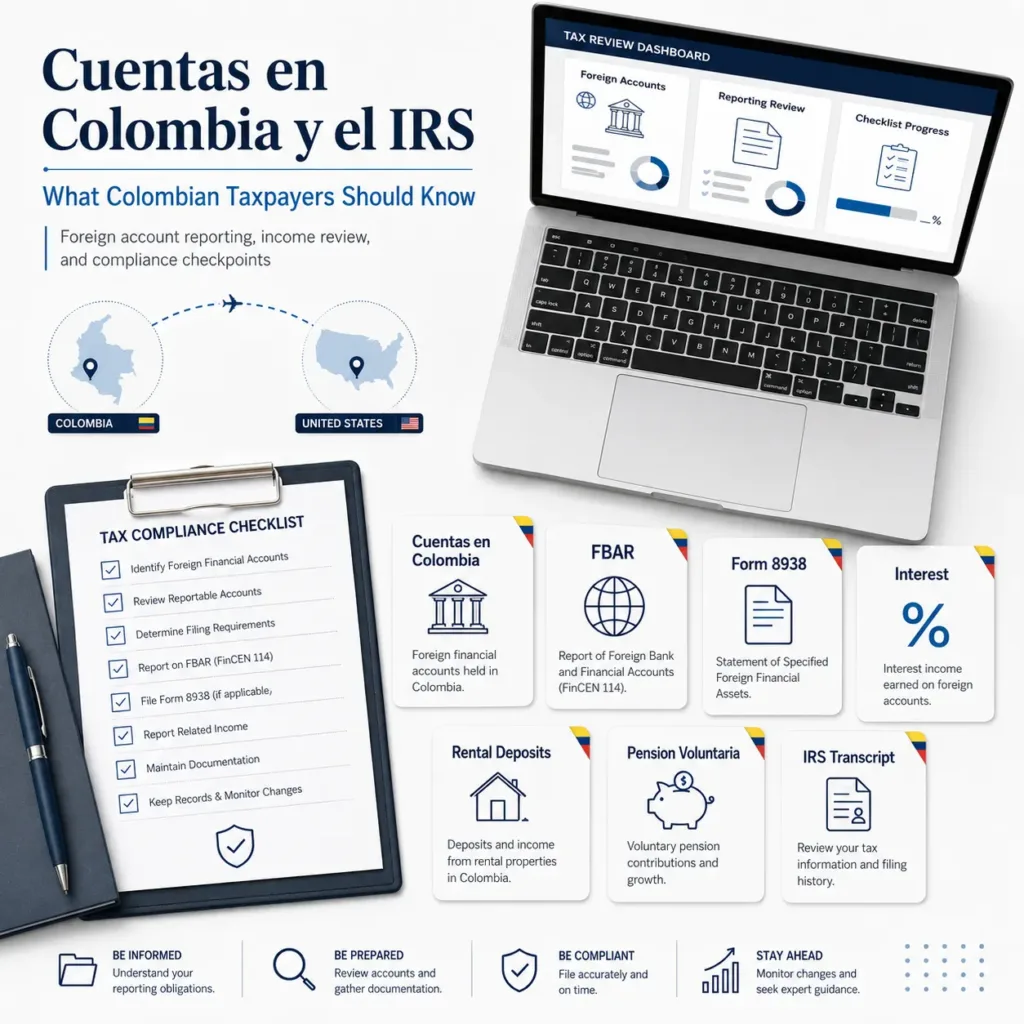
You live in Miami, but you still have cuentas en Colombia.
Maybe it is a savings account in Bancolombia, Davivienda, Banco de Bogotá, BBVA, or another Colombian financial institution. Maybe the account is small. Maybe it is for family expenses. Maybe it holds rental income from an apartment in Colombia. Maybe it is connected to a pension voluntaria, investment account, or Colombian business activity.
And now you are asking:
Does the IRS care about my Colombian bank account?
The calm answer is: maybe. Do not panic, but do not ignore it either.
For Colombian taxpayers in Miami, Colombian accounts can create several different U.S. tax and reporting questions. Some are about income. Some are about account reporting. Some are about foreign financial assets. Some are about whether your prior preparer even asked the right intake questions.
If your return was already filed and nobody asked about cuentas en Colombia, this article explains what to check first.
For the broader prior-preparer concern, also read: Me Prepararon Mal Los Taxes? What Colombianos en Miami Should Check First.
Quick Answer:
Cuentas en Colombia can matter for U.S. taxpayers even if the account produced little income. A Colombian bank account may raise FBAR questions, Form 8938 questions, income reporting questions, foreign tax credit issues, pension or investment reporting concerns, and IRS transcript review issues. The account balance, ownership, signature authority, income earned, and the taxpayer’s U.S. status all matter.
First, Separate Income From Account Reporting
One of the biggest mistakes is mixing together two different questions:
- Did the Colombian account produce income?
- Did the Colombian account itself need to be reported?
Those are not the same thing.
A Colombian account may produce interest, dividends, investment income, rental deposits, business receipts, or pension-related activity. That is an income tax question.
Separately, the account may need to be reported because it is a foreign financial account or specified foreign financial asset. That is an account reporting question.
For example, a Colombian savings account could produce a small amount of interest. The interest may be income. But the account balance may also matter for FBAR or Form 8938 depending on the facts.
This is why “it did not earn much interest” is not the end of the analysis.
If you are still unsure whether Colombian income belongs on a U.S. tax return, read: Do Colombians in Miami Need to Report Colombian Income on U.S. Taxes?.
Why FBAR Comes Up With Colombian Accounts
FBAR stands for Report of Foreign Bank and Financial Accounts.
FinCEN says a United States person with a financial interest in, or signature authority over, foreign financial accounts must file an FBAR if the aggregate value of those foreign financial accounts exceeds $10,000 at any time during the calendar year.
That threshold is important because it is based on the aggregate value of foreign financial accounts. It is not only about one account. It is not only about interest earned.
For Colombian taxpayers in Miami, FBAR questions may come up with:
- Colombian checking accounts
- Colombian savings accounts
- Investment accounts
- Brokerage accounts
- Accounts where you have signature authority
- Some pension or retirement-style accounts depending on the facts
- Accounts connected to rental property or family financial activity
FBAR is not filed with your Form 1040. The IRS explains that FBAR is filed electronically through FinCEN’s BSA E-Filing System and should not be filed with your federal income tax return.
That means a taxpayer can file a U.S. tax return and still miss a separate FBAR issue.
For the deeper education article, read: FBAR vs Form 8938 for Colombian Accounts.
Why Form 8938 Is a Separate Question
Form 8938 is not the same as FBAR.
The IRS says Form 8938 is used to report specified foreign financial assets if the total value of those assets is more than the appropriate reporting threshold.
The IRS also explains that the Form 8938 filing requirement does not replace or otherwise affect a taxpayer’s obligation to file FBAR, and that FBAR is filed separately with FinCEN, not the IRS.
That means a Colombian taxpayer may need:
- FBAR only
- Form 8938 only
- Both FBAR and Form 8938
- Neither form
It depends on the account type, value, ownership, filing status, where the taxpayer lives, and whether the reporting thresholds are met.
Common mistakes include:
- “I filed my tax return, so the account is handled.”
- “My preparer listed foreign income, so FBAR is handled.”
- “I filed FBAR, so Form 8938 is not needed.”
- “I filed Form 8938, so FBAR is not needed.”
- “The account is in Colombia, so the IRS will not know.”
- “The account did not produce income, so no reporting is needed.”
Those assumptions can be risky.
Colombian Accounts Can Also Reveal Income Issues
A Colombian bank account is not only a reporting issue. It can also point to income that should have been reviewed.
Ask yourself what moved through the account:
- Interest
- Dividends
- Rental deposits
- Pension distributions
- Business receipts
- Property sale proceeds
- Investment income
- Family transfers that may need classification
- Foreign taxes paid or withheld
For U.S. citizens and resident aliens, the IRS says worldwide income from all sources is generally subject to U.S. tax reporting rules. IRS Publication 54 also explains that worldwide income is generally subject to U.S. income tax for U.S. citizens and resident aliens regardless of where they live.
So the account itself may raise one question, and the activity inside the account may raise another.
If your concern is broader than bank accounts, read: Common U.S. Tax Return Mistakes for Dual U.S./Colombian Taxpayers.
What If the Account Is Just for Family or Personal Use?
Many taxpayers say:
“It is just my Colombian account.”
“It is for my mamá.”
“It is just for travel.”
“It is not a business account.”
“It is only there because I still have property in Colombia.”
Those facts matter, but they do not automatically remove the reporting question.
A personal Colombian account can still be a foreign financial account. A small account may not meet a filing threshold, but that needs to be checked. An account held jointly with a family member can raise ownership and reporting questions. An account where you only have signature authority may still matter.
The point is not that every Colombian account creates a filing obligation. The point is that the account should be reviewed before assuming it is irrelevant.
What If the Account Is Connected to Colombian Property?
A Colombian account is often connected to real estate.
Maybe tenants deposit rent into the account. Maybe the account pays property taxes, HOA fees, repairs, utilities, or mortgage payments. Maybe sale proceeds from an apartment went into the account.
That creates a separate tax return question.
If the account received rental income or sale proceeds, the U.S. return may need to review income, expenses, depreciation, capital gains, foreign taxes, and currency conversion. The account may also still raise FBAR or Form 8938 questions.
For that topic, read: Colombian Property, Rental Income, and U.S. Tax Return Risk.
What If Colombian Tax Was Paid?
If Colombian taxes were withheld or paid on income connected to the account, that does not automatically finish the U.S. side.
The IRS explains that the foreign tax credit may apply to certain foreign taxes paid or accrued to a foreign country or U.S. possession, subject to rules and limits.
For Colombian taxpayers, this can matter when the account receives:
- Rental income
- Pension income
- Interest
- Dividends
- Business income
- Property sale proceeds
- Other Colombia-source income
A common mistake is reporting nothing in the U.S. because tax was paid in Colombia. Another mistake is reporting the income but missing the foreign tax credit analysis.
For the next education step, read: Foreign Tax Credit Mistakes for Colombians Filing U.S. Returns.
What If the Account Is a Pension Voluntaria or Investment Account?
Pension voluntaria and Colombian investment accounts can be more complex than ordinary checking accounts.
They may raise questions about:
- Account ownership
- Contributions
- Distributions
- Account growth
- Underlying investments
- Foreign taxes paid
- FBAR
- Form 8938
- Whether income was reported correctly
Do not assume “it is a pension” means the U.S. ignores it. Also do not assume it is automatically taxed the same way as a U.S. retirement account.
The awareness-level takeaway is simple: if your preparer never asked about Colombian pension accounts, investment accounts, or pension voluntaria, your return may deserve a second look.
Can an IRS Transcript Show Colombian Accounts?
Usually, an IRS transcript will not show every Colombia-side fact.
IRS transcripts can help show return processing, refund activity, payments, balances, penalties, filing history, and wage and income information that was reported to the IRS. The IRS Get Transcript page explains that taxpayers can access tax return transcripts, tax account transcripts, wage and income transcripts, and verification of non-filing letters.
But a Colombian bank account may not appear on a wage and income transcript if no U.S. payer reported anything to the IRS.
That means a clean IRS transcript does not automatically mean Colombian accounts were handled correctly.
A transcript review can help with the IRS-side picture. Colombian account documents help with the foreign account and income picture. You often need both to understand the risk.
Related education article: How IRS Transcripts Can Reveal Refunds, Penalties, and Filing Problems.
What If My Preparer Never Asked About Cuentas en Colombia?
That is a red flag.
It does not automatically prove the return was wrong. But it does mean important facts may not have been reviewed.
A proper intake for a Colombia-connected U.S. return should ask questions like:
- Did you have Colombian bank accounts?
- What was the highest balance?
- Were there multiple accounts?
- Did you have signature authority over any account?
- Did the account earn interest?
- Did the account receive rent, dividends, pension, or business income?
- Did you have Colombian investment accounts?
- Did you have pension voluntaria?
- Did you file FBAR?
- Did anyone consider Form 8938?
- Was Colombian tax paid or withheld?
If those questions were never asked, the issue may not be the math. The issue may be missing facts.
Missing facts are what my FBAR emails try to surface, because the questions nobody asked you are the ones that decide whether a report was owed. Across the five I go through what counts toward the reporting threshold once several small accounts are added together, whose accounts land on your report even where your name is not on the title, and what a correction looks like once you know. Send me the five FBAR emails. A confirmation note comes first and the series does not begin until you click it, and you can stop them at any point from the unsubscribe link. None of it replaces a proper intake on your own file.
Review Issue or Tax Resolution Issue?
Not every Colombian account concern is an IRS emergency.
This may be a review issue if:
- You are unsure whether anything is wrong
- Your preparer never asked about Colombian accounts
- You had accounts but no active IRS notice
- You want to understand whether FBAR or Form 8938 may apply
- You want to compare IRS records with your filed return
- You want to identify refund or risk indicators before amending
This may already be a tax resolution issue if:
- You received an IRS notice
- You owe a balance
- You have penalties
- You have unfiled returns
- You have an audit
- You have collection activity
- You have a lien, levy, or CP2000-style mismatch issue
If it is still a personal return review concern, Edward Parsons CPA offers a CPA-led Tax Refund & Risk Assessment (Personal), an IRS transcript-based CPA review for refund opportunities, penalties, filing issues, and personal tax risks. The personal assessment is positioned for Form 1040 concerns, personal refunds, Colombian income, Colombian bank account concerns, FBAR/Form 8938 flags, foreign tax credit issues, and prior personal return second opinions.
If the issue involves a business, LLC, corporation, partnership, payroll tax, business penalty, or business IRS account activity, the better route may be Tax Refund & Risk Assessment (Business). If there is already an IRS notice, balance, penalty, lien, levy, audit, or collection problem, the better route may be Personal CPA Tax Resolution Case Analysis.
Safely Report Colombian Bank Accounts: Your Next Steps
If you have cuentas en Colombia and filed a U.S. return, do not assume the account was handled just because the return was accepted.
Start by separating the issues:
- Did the account produce income?
- Did the account receive rental, pension, business, or investment funds?
- What was the highest account value?
- Did you have multiple foreign accounts?
- Did you have signature authority?
- Did anyone ask about FBAR?
- Did anyone ask about Form 8938?
- Did the return include Colombian income?
- Did the return consider Colombian taxes paid?
- Does the IRS-side record show anything unexpected?
Then continue through the cluster:
- Do Colombians in Miami Need to Report Colombian Income on U.S. Taxes?
- Me Prepararon Mal Los Taxes? What Colombianos en Miami Should Check First
- Common U.S. Tax Return Mistakes for Dual U.S./Colombian Taxpayers
- FBAR vs Form 8938 for Colombian Accounts
- How IRS Transcripts Can Reveal Refunds, Penalties, and Filing Problems
- Foreign Tax Credit Mistakes for Colombians Filing U.S. Returns
- CPA Tax Return Review for Colombians in Miami
Tranquilo. The goal is not to panic. The goal is to understand whether your Colombian accounts were properly considered before you ignore the issue, amend too fast, or wait for the IRS to ask first.
Cuentas en Colombia y el IRS: Common Questions
These FAQs help Colombian taxpayers in Miami understand when Colombian accounts may raise U.S. tax return, FBAR, Form 8938, transcript, or CPA review questions.
Does the IRS care about cuentas en Colombia?
The IRS and FinCEN may care depending on your U.S. tax status, account value, income, ownership, and signature authority. A Colombian account can raise income reporting questions, FBAR questions, Form 8938 questions, or all three.
If you are still learning the broader issue, read Do Colombians in Miami Need to Report Colombian Income on U.S. Taxes? .
Official source: IRS worldwide income guidance
Do I need to file FBAR for a Colombian bank account?
You may need to file FBAR if you are a United States person with a financial interest in, or signature authority over, foreign financial accounts and the aggregate value of those accounts exceeded $10,000 at any time during the calendar year.
For the deeper comparison, read FBAR vs Form 8938 for Colombian Accounts .
Official source: FinCEN FBAR guidance
Is FBAR filed with my U.S. tax return?
No. FBAR is filed electronically through FinCEN’s BSA E-Filing System. It is not filed with your federal income tax return.
This is why a tax return can be filed and accepted while a separate foreign account reporting issue still exists.
Official source: IRS guidance on how to report foreign bank and financial accounts
What is the difference between FBAR and Form 8938?
FBAR and Form 8938 are separate reporting regimes. FBAR is filed with FinCEN and generally focuses on foreign financial accounts. Form 8938 is filed with the IRS and reports specified foreign financial assets when the taxpayer exceeds the applicable reporting threshold.
Filing one does not automatically satisfy the other. Read FBAR vs Form 8938 for Colombian Accounts for the next education step.
Official source: IRS comparison of Form 8938 and FBAR requirements
Do Colombian accounts matter if they did not earn interest?
They may. FBAR and Form 8938 questions can depend on account value and asset reporting rules, not only whether interest was earned. Separately, any income earned in the account may also need tax return review.
If your preparer never asked about cuentas en Colombia, read Me Prepararon Mal Los Taxes? What Colombianos en Miami Should Check First .
Official source: IRS Form 8938 guidance
What if my Colombian account receives rental income?
Then you may have both an account reporting issue and an income tax issue. Rental deposits, expenses, depreciation, foreign taxes, and property ownership facts may need review on the U.S. return.
Read Colombian Property, Rental Income, and U.S. Tax Return Risk .
Official source: IRS Publication 54
What if Colombian tax was paid on income in the account?
Paying Colombian tax does not automatically remove the U.S. reporting requirement. The U.S. return may still need to report the income and then evaluate whether a foreign tax credit or deduction applies.
Read Foreign Tax Credit Mistakes for Colombian Taxes Paid .
Official source: IRS foreign tax credit guidance
Can IRS transcripts show Colombian bank accounts?
Not usually by themselves. IRS transcripts can show return processing, refund activity, balances, penalties, and certain wage and income records, but Colombian accounts may not appear if no U.S. payer reported account income to the IRS.
To understand the IRS-side record, read How IRS Transcripts Reveal Refunds, Penalties, and Filing Issues .
Official source: IRS Get Transcript
Should I amend my tax return if I forgot Colombian accounts?
Not automatically. First identify whether the issue is income, FBAR, Form 8938, foreign tax credit, IRS transcript activity, or a known IRS notice. Different issues may require different next steps.
If this is still unclear, start with Common U.S. Tax Return Mistakes for Dual U.S./Colombian Taxpayers .
Official source: IRS amended return guidance
When should I use a personal review, business review, or tax resolution analysis?
Use a personal review when the concern is your Form 1040, refund, Colombian accounts, Colombian income, foreign tax credit, FBAR, Form 8938, or personal IRS transcript. Use a business review when the issue involves an LLC, corporation, partnership, payroll, business penalties, or business IRS account. Use tax resolution analysis when there is already an IRS notice, balance, penalty, lien, levy, audit, or collection problem.
Personal route: Tax Refund & Risk Assessment (Personal) . Business route: Tax Refund & Risk Assessment (Business) . Known IRS problem route: Personal CPA Tax Resolution Case Analysis .
Official source: IRS choosing a tax professional