Skip to content
You have cuentas en Colombia. Maybe one account. Maybe several. Maybe a savings account, checking account, investment account, pension voluntaria, or account connected to Colombian rental property.
Now you are wondering: Does this belong on my U.S. tax return? Do I need FBAR? What about Form 8938?
For Colombian taxpayers in Miami, this is one of the most common areas where a tax return can look “accepted” but still deserve a second look. The issue is not only whether the account earned interest. The issue may involve account value, ownership, signature authority, foreign income, Form 8938, FBAR, FATCA, foreign tax credits, and whether your preparer asked the right questions.
If you need the broader awareness article first, read: Cuentas Bancarias Colombianas y Reportes IRS, FBAR, 8938, FATCA.
Quick Answer:
Colombian bank accounts can create U.S. reporting issues even when the account earned little or no income. FBAR generally applies when a U.S. person has foreign financial accounts with aggregate value over $10,000 at any time during the year. Form 8938 is a separate IRS form for specified foreign financial assets when the taxpayer exceeds the applicable threshold. Some taxpayers may need FBAR, Form 8938, both, or neither, depending on the facts.
First, Separate Three Different Questions
Most taxpayers mix three issues together:
- Did the Colombian account produce income?
- Did the Colombian account need to be reported on FBAR?
- Did the Colombian account or asset need to be reported on Form 8938?
Those are separate questions.
A Colombian account may produce income such as interest, dividends, rental deposits, pension distributions, or business receipts. That is an income tax question.
FBAR is a foreign account reporting question.
Form 8938 is a foreign financial asset reporting question.
A taxpayer may have one issue, two issues, all three, or none. That is why “the account did not earn much interest” is not enough to decide whether anything was required.
For the broader Colombia income issue, read: Do Colombians in Miami Need to Report Colombian Income on U.S. Taxes?.
What Is FBAR?
FBAR means Report of Foreign Bank and Financial Accounts.
FinCEN says a United States person with a financial interest in, or signature authority over, foreign financial accounts must file an FBAR when the aggregate value of those foreign financial accounts exceeds $10,000 at any time during the calendar year. The IRS comparison page also explains that the FBAR threshold is cumulative, meaning multiple accounts are combined for the threshold.
For Colombian taxpayers, this may include:
- Colombian checking accounts
- Colombian savings accounts
- Colombian brokerage or investment accounts
- Accounts where you have signature authority
- Certain foreign pension or retirement-style accounts depending on facts
- Accounts connected to rental property or Colombian business activity
FBAR is not filed with your Form 1040. The IRS explains that Form 8938 is filed with the federal income tax return, while FBAR is separate and filed through FinCEN.
That is one reason this issue gets missed. A tax preparer may file your return, the IRS may accept it, and there may still be a separate FBAR question.
What Is Form 8938?
Form 8938 is the IRS form used to report specified foreign financial assets when the total value of those assets is more than the applicable reporting threshold.
For many taxpayers living in the United States, the IRS comparison page lists these Form 8938 thresholds:
- Single or married filing separately: more than $50,000 on the last day of the tax year, or more than $75,000 at any time during the year
- Married filing jointly: more than $100,000 on the last day of the tax year, or more than $150,000 at any time during the year
For specified individuals living outside the United States, the thresholds are higher.
This article is focused on Colombians in Miami, so the U.S.-resident thresholds are usually the first place to check. But the correct threshold depends on filing status, residency facts, and asset type.
For a more direct comparison, the next education article is: FBAR vs Form 8938 for Colombian Accounts.
Why Colombian Accounts Are Easy to Miss
Colombian accounts are often missed because the taxpayer does not think of them as “U.S. tax items.”
Common explanations include:
- “It is just my Colombia account.”
- “The money never came to the U.S.”
- “It is for family expenses.”
- “The account did not earn income.”
- “My Colombian accountant handled that.”
- “I already paid tax in Colombia.”
- “My U.S. preparer never asked.”
Those facts may matter, but they do not automatically remove the U.S. question.
For U.S. citizens and resident aliens, the IRS says worldwide income is generally subject to U.S. income tax regardless of where the taxpayer lives. That means income connected to a Colombian account may still need review on the U.S. return.
The account itself can also matter separately from the income.
That is the key point: income reporting and account reporting are not the same thing.
Examples of Colombian Accounts That May Need Review
A Colombian account should be reviewed if it involves:
- Savings or checking balances
- Interest income
- Dividends or investment earnings
- Brokerage activity
- Rental deposits
- Property sale proceeds
- Pension distributions
- Pension voluntaria
- Business receipts
- Joint ownership with family
- Signature authority only
- Accounts used for family or property management
Not every account creates a filing obligation. But if your preparer never asked about account values, account types, highest balances, or signature authority, the return process may have missed a major fact category.
For prior-preparer concerns, read: Me Prepararon Mal Los Taxes? What Colombianos en Miami Should Check First.
FBAR vs Form 8938: The Practical Difference
Here is the simple way to understand it.
FBAR is mainly about foreign financial accounts and is filed separately with FinCEN.
Form 8938 is an IRS form attached to the federal income tax return when specified foreign financial assets exceed the applicable threshold.
The IRS says taxpayers may need Form 8938, FBAR, or both depending on their situation, and certain foreign accounts may need to be reported on both forms.
A Colombian bank account may be relevant to both. But the rules are not identical.
Do not assume:
- FBAR replaces Form 8938.
- Form 8938 replaces FBAR.
- Filing a tax return means FBAR was handled.
- No income means no reporting.
- A Colombian bank account is too foreign for the IRS to care.
A clean review should ask both questions separately.
What If the Account Earned Interest?
Interest income is an income tax issue.
If you are a U.S. citizen or resident alien, foreign interest income may belong on the U.S. return. The IRS states that U.S. citizens and residents must consider gross income from worldwide sources when determining filing requirements, and foreign currency amounts reported on a U.S. return must be expressed in U.S. dollars.
That means the review may need to consider:
- Interest income
- Colombian tax withheld
- Exchange rates
- Whether Form 1116 foreign tax credit applies
- Whether the account also triggers FBAR or Form 8938
If Colombian tax was paid or withheld, read: Foreign Tax Credit Mistakes for Colombians Filing U.S. Returns.
What If the Account Is Connected to Colombian Property?
Many Colombian taxpayers in Miami keep an account in Colombia because they own property there.
That account may receive rent, pay property expenses, hold sale proceeds, or pay Colombian property taxes.
If rental income or sale proceeds moved through the account, the issue is no longer only FBAR or Form 8938. The U.S. return may also need to review:
- Rental income
- Expenses
- Depreciation
- Colombian taxes paid
- Sale proceeds
- Capital gain or loss
- Currency conversion
- Whether the property was held personally or through an entity
For property-specific issues, read: Colombian Property, Rental Income, and U.S. Tax Return Risk.
What If the Account Is a Pension Voluntaria or Investment Account?
A Colombian pension voluntaria or investment account may require more review than a regular checking account.
The issue may involve:
- Whether it is a foreign financial account
- Whether it is a specified foreign financial asset
- Whether there were distributions
- Whether there was account growth
- Whether there are underlying investments
- Whether any foreign tax was paid
- Whether FBAR applies
- Whether Form 8938 applies
Do not assume a Colombian pension account is treated the same as a U.S. retirement account. Also do not assume it is irrelevant because no money was withdrawn.
If this was never discussed when your return was prepared, that is a reason to slow down and classify the issue before amending or ignoring it.
Can IRS Transcripts Show Colombian Bank Accounts?
Usually, IRS transcripts will not show the full Colombia-side picture.
IRS transcripts can help show filing history, refund activity, balances, penalties, payments, and U.S.-reported wage and income items. But Colombian accounts may not appear on an IRS wage and income transcript if no U.S. payer reported income to the IRS.
That means a clean transcript does not automatically mean your Colombian accounts were handled correctly.
The transcript is one layer. The Colombian documents are another layer.
For the IRS-side review, read: How IRS Transcripts Can Reveal Refunds, Penalties, and Filing Problems.
Review Issue, Filing Issue, or Tax Resolution Problem?
Not every Colombian account concern is an emergency.
This may be a review issue if:
- You are unsure whether anything is wrong
- You had cuentas en Colombia but no active IRS notice
- Your preparer never asked about FBAR or Form 8938
- You want to understand whether your return missed something
- You want to check IRS transcript indicators first
This may be a form filing issue if:
- You already know FBAR was required but not filed
- You already know Form 8938 was required but not filed
- You need current-year or prior-year foreign account form preparation
- You need account values, classifications, or thresholds reviewed
This may already be a tax resolution issue if:
- You received an IRS notice
- You have penalties
- You have unfiled returns
- You owe a balance
- You have an audit, lien, levy, or collection issue
- You have a CP2000-style mismatch issue
Edward Parsons CPA offers a CPA-led Tax Refund & Risk Assessment (Personal) for personal return concerns involving refund opportunities, penalties, filing issues, IRS transcript indicators, and personal tax risks. For business accounts, payroll indicators, or entity-level concerns, the better route may be the Tax Refund & Risk Assessment (Business).
If the issue is specifically preparing FBAR or Form 8938, Edward Parsons CPA also has separate CPA-prepared form services for FinCEN Form 114 FBAR Filing for Foreign Financial Accounts and Form 8938 CPA FATCA Filing for Foreign Financial Assets.
If you already have an IRS notice, penalty, balance, audit, lien, levy, or collection issue, the issue may be beyond a basic review. In that situation, Personal CPA Tax Resolution Case Analysis may be the more appropriate route.
The Safer Next Step
If you have Colombian bank accounts, do not guess and do not assume the account was handled just because your tax return was accepted.
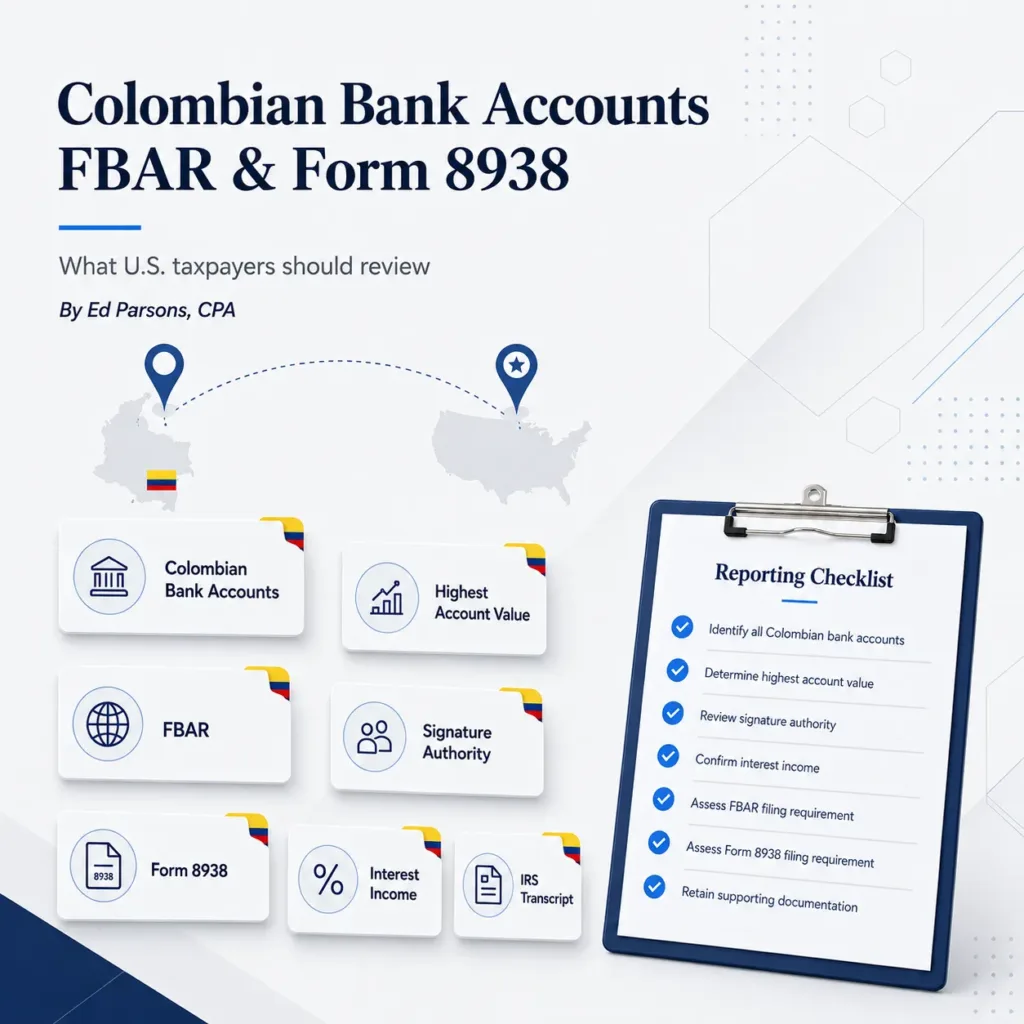
Start by identifying:
- What accounts existed
- Who owned them
- Whether you had signature authority
- The highest value during the year
- Whether the account earned income
- Whether the account received rent, pension, business income, or sale proceeds
- Whether FBAR was considered
- Whether Form 8938 was considered
- Whether Colombian tax was paid
- Whether the IRS-side record shows anything unexpected
Then continue through the cluster:
- Taxes Colombia USA: What Dual Citizens Often Miss
- Cuentas Bancarias Colombianas y Reportes IRS, FBAR, 8938, FATCA
- Common U.S. Tax Return Mistakes for Dual U.S./Colombian Taxpayers
- FBAR vs Form 8938 for Colombian Accounts
- Foreign Tax Credit Mistakes for Colombians Filing U.S. Returns
- How IRS Transcripts Can Reveal Refunds, Penalties, and Filing Problems
- CPA Tax Return Review for Colombians in Miami
Tranquilo. The goal is not to panic. The goal is to understand which issue you actually have: income, FBAR, Form 8938, foreign tax credit, transcript review, form preparation, or tax resolution.
Colombian Bank Accounts, FBAR, and Form 8938: Common Questions
These FAQs help Colombian taxpayers in Miami understand when Colombian accounts may raise FBAR, Form 8938, income, IRS transcript, or CPA review questions.
Do Colombian bank accounts have to be reported to the IRS?
They may. A Colombian account can raise income reporting questions, FBAR questions, Form 8938 questions, or all three. The answer depends on your U.S. tax status, account value, ownership, signature authority, and income activity.
For the broader account article, read Cuentas Bancarias Colombianas y Reportes IRS, FBAR, 8938, FATCA .
Official source: IRS comparison of Form 8938 and FBAR requirements
What is the FBAR threshold for Colombian accounts?
FBAR generally applies when a U.S. person has a financial interest in, or signature authority over, foreign financial accounts and the aggregate value of those accounts exceeds $10,000 at any time during the calendar year.
This is an aggregate threshold. Multiple Colombian and foreign accounts can be combined for the test.
Official source: FinCEN FBAR guidance
Is FBAR filed with my federal tax return?
No. FBAR is filed separately through FinCEN. It is not attached to Form 1040. This is why a U.S. return can be accepted even when a separate FBAR issue still needs review.
If your preparer never mentioned FBAR, read Me Prepararon Mal Los Taxes? What Colombianos en Miami Should Check First .
Official source: IRS details on reporting foreign bank and financial accounts
What is Form 8938?
Form 8938 is used to report specified foreign financial assets when the total value of those assets is more than the applicable reporting threshold. It is filed with the federal income tax return.
For a deeper comparison, read FBAR vs Form 8938 for Colombian Accounts .
Official source: IRS Form 8938 guidance
Can I need both FBAR and Form 8938?
Yes. Depending on the facts, a taxpayer may need FBAR, Form 8938, both, or neither. Filing one does not automatically satisfy the other.
If you are trying to understand which rule applies, read FBAR vs Form 8938 for Colombian Accounts .
Official source: IRS details on FBAR and Form 8938 overlap
Do Colombian accounts matter if they earned no interest?
They may. FBAR and Form 8938 can depend on account value and asset reporting rules, not only whether the account earned interest. Separately, any income the account did earn may still need review.
If the account received Colombian income, also read Do Colombians in Miami Need to Report Colombian Income on U.S. Taxes? .
Official source: IRS comparison of Form 8938 and FBAR requirements
What if my Colombian account received rental income?
Then there may be both an account reporting issue and an income tax issue. Rental deposits, property expenses, depreciation, foreign taxes, and property ownership facts may need review.
Read Colombian Property, Rental Income, and U.S. Tax Return Risk .
Official source: IRS Publication 54
Can IRS transcripts show Colombian bank accounts?
Usually not by themselves. IRS transcripts can show IRS-side filing history, refunds, payments, balances, penalties, and certain income records. But Colombian accounts may not appear if no U.S. payer reported income to the IRS.
Read How IRS Transcripts Reveal Refunds, Penalties, and Filing Issues .
Official source: IRS Get Transcript
Should I amend my tax return if Colombian accounts were missed?
Not automatically. First identify whether the issue is income, FBAR, Form 8938, foreign tax credit, transcript activity, or a known IRS problem. Different issues may require different next steps.
If the issue is still unclear, read Common U.S. Tax Return Mistakes for Dual U.S./Colombian Taxpayers .
Official source: IRS amended return guidance
When should I use a review, FBAR filing, Form 8938 filing, or tax resolution analysis?
Use a personal review when you are unsure whether your Form 1040, refund, Colombian accounts, foreign income, foreign tax credit, or IRS transcript record was handled correctly. Use FBAR or Form 8938 filing services when you already know those forms need preparation. Use tax resolution analysis when there is already an IRS notice, balance, penalty, lien, levy, audit, or collection problem.
Personal review: Tax Refund & Risk Assessment (Personal) . FBAR filing: FinCEN Form 114 FBAR Filing . Form 8938 filing: Form 8938 CPA FATCA Filing . Known IRS problem: Personal CPA Tax Resolution Case Analysis .
Official source: IRS choosing a tax professional