Skip to content

Consultation costs for FBAR and foreign trust matters depend on filing history, number of unfiled years, trust complexity, and whether Streamlined Filing Compliance Procedures apply. Foreign trusts with U.S. beneficiaries face FBAR reporting on accounts exceeding aggregate thresholds, plus Forms 3520 and 3520-A, each adding preparation scope, penalty exposure, and reconstruction work that shapes total consultation and engagement pricing.
Key Takeaways
- U.S. persons with foreign trusts face both income tax consequences and mandatory information reporting requirements annually.
- FBAR filing deadline occurs June 30th each year for all foreign bank and financial accounts.
- Foreign accounts create reporting obligations even when taxpayers owe little or no U.S. income tax.
- Failure to satisfy foreign trust information reporting requirements results in significant penalties for noncompliance.
Why Does Foreign Trust FBAR Pricing Vary So Much?
Foreign trust cases cost more to prepare than a standard FBAR filing because the trust itself often triggers separate reporting duties layered on top of the account disclosure. A grantor with signature authority over a foreign account may need only the FinCEN Form 114 in a simple case. A foreign trust, however, frequently carries additional obligations that go well beyond that single form, and each added layer increases the analysis, documentation, and time involved in determining the cost for FBAR foreign trust consultation services.
What Makes Foreign Trust Reporting More Complex Than a Standard FBAR?
Trusts organized outside the United States are not automatically treated the same as U.S. persons under the reporting rules. That distinction matters because it can open the door to additional filings tied to distributions, ownership, or trust activity during the year. A preparer has to trace the trust’s structure, its beneficiaries, and its transaction history before pricing the engagement accurately.
Several factors typically drive the fee up or down:
- Number of trust years requiring reconstruction
- Whether beneficiaries received distributions
- Complexity of the trust’s underlying investments
- Volume and clarity of available account records
Why Does It Matter If the IRS Already Knows About the Account?
Foreign banks now report American account holders directly to the IRS under FATCA, meaning the government frequently already holds account data before a return is filed. That reality raises the stakes of an incomplete or careless filing.
A boutique, remote practice built around direct access to the CPA handling the case scopes each foreign trust consultation individually, with pricing reflecting the specific details of each case; published packages are on the store.
How Do You Determine the Cost for FBAR Foreign Trust Consultation Services?
Cost depends on scope. Determining the cost for FBAR foreign trust consultation services starts with mapping out how many years of returns, disclosures, and trust forms a client’s situation actually requires. A missed FBAR alongside a foreign trust interest typically involves multiple forms. Pricing has to reflect that reality.
What does a baseline streamlined filing engagement include?
A standard streamlined engagement has a defined shape: three years of amended or delinquent tax returns, six years of FBARs, and a signed certification statement explaining the underlying conduct. That fixed scope gives Edward Parsons, CPA a starting framework for quoting fees before layering in trust-specific complexity.
Does foreign trust status change the price?
Yes. Whether a taxpayer qualifies for the no-penalty foreign resident track or falls under the 5 percent domestic track changes how much factual digging the engagement requires. Foreign-track taxpayers typically face a narrower penalty exposure, which can mean less time spent building a penalty-mitigation record. Domestic-track cases usually demand deeper documentation, which adds hours and cost.
Several factors drive the final quote:
- Number of open years needing returns, FBARs, or trust-related forms
- Track eligibility — foreign versus domestic streamlined status
- Trust complexity, including whether the client is a grantor, beneficiary, or both
- Volume of source documents, such as foreign bank statements and trust distribution records
Because Edward Parsons, CPA operates as a single-CPA practice, the person who quotes the engagement is also the person preparing the returns. That structure allows consultation time to be spent evaluating facts directly, rather than passing details through multiple reviewers before pricing is finalized, which keeps foreign trust consultation fees tied to the actual work involved rather than administrative layers.
Stakes matter here too. Foreign trust information reporting failures can trigger significant penalties. Extend how long the IRS has to assess tax on the related years. That extended exposure is part of what any serious cost estimate has to account for. Underscoping the engagement often costs more later than pricing it accurately at the start.
What Filing History and Forms Drive the Price?
Filing history and form complexity set the foreign trust consultation cost more than any other single factor, and IRS Form 3520 cost factors specifically often carry the most weight in that calculation. A trust’s classification determines which forms apply, and that determination has to happen before any return gets prepared.
Does the trust even count as a foreign trust?
Classification comes first. The IRS treats a trust as foreign when it is not considered a U.S. person under the tax code, and reaching that conclusion requires reviewing trust documents, trustee residency, and control provisions. Two trusts holding identical assets can land in different reporting categories depending on these facts. That difference changes both the required forms and the associated review time.
Account structure matters just as much as classification. A managed investment fund often reports through one consolidated figure. A foreign trust holding its own bank accounts rarely gets that shortcut. Each account tied to the trust may need separate identification, valuation, and disclosure work, multiplying the effort behind FBAR and Form 3520 preparation.
Why do foreign funds inside a trust raise the price?
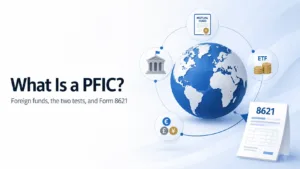
Foreign-domiciled funds held inside a trust typically trigger PFIC (Passive Foreign Investment Company) treatment. That status adds Form 8621 analysis to the engagement. A trust holding a European fund or offshore ETF isn’t safe simply because its underlying holdings include U.S. stocks; domicile decides PFIC status, not what the fund actually invests in.
That domicile rule creates a multiplier effect. A trust holding three foreign funds across three countries needs three separate PFIC analyzes, not one blended calculation. These factors typically expand the scope of work:
- Number of foreign trust accounts requiring separate FBAR line items
- Number of foreign-domiciled funds requiring individual Form 8621 review
- Complexity of trustee, beneficiary, and control provisions driving classification
- Years of unfiled or incomplete prior returns requiring reconstruction
Each factor compounds rather than simply adds, which explains why two trusts with similar total assets can carry very different filing costs.
Does Account Complexity Change the Consultation Cost?
Yes, account complexity drives most of the variation in FBAR foreign trust consultation pricing, and it’s a major reason offshore trust FBAR compliance fees are rarely quoted as a flat rate. A client with one clean foreign bank account and a single open tax year requires far less review than someone with a trust, multiple accounts, and several years of unfiled returns. The gap between those two scenarios shows up directly in the time a CPA needs before quoting a fee.
Origin matters too. Foreign accounts tied to a new overseas job carry different documentation than accounts inherited from a relative or accounts held through a stake in a foreign business. Each situation brings its own paper trail, and that paper trail shapes how long a review takes.
Why does reviewing multiple tax years cost more than reviewing one?
Multi-year cases require pulling and reading IRS account transcripts for every open year, not just the most recent one. Transaction codes like Code 150, which confirms a return was filed and assessed, need to be checked across each year before anyone can quote an accurate fee. Comparing transcript codes across five years takes considerably longer than confirming a single filing year is clean.
Does a related business audit affect the price?
It can. A business owner also facing a state audit notice typically has around 30 days to respond. That compressed deadline changes how a combined engagement gets priced.
Complexity factors that raise consultation scope:
- Number of open tax years requiring transcript review
- Whether a foreign trust, not just a foreign account, is involved
- Multiple account origins (employment, inheritance, business ownership)
- Overlapping state or federal audit deadlines
What Should You Do Before You Get a Quote?
Preparation, not price shopping, determines whether a foreign trust consultation stays affordable or turns into a drawn-out project. Understanding FBAR foreign trust advisor pricing before the first meeting also sets realistic expectations for what an international tax CPA consultation cost should cover. Taxpayers who gather their records first give a preparer the ability to scope the work accurately, rather than pricing in guesswork for unknowns that surface later.
Speed matters too. Acting quickly once a filing gap or an IRS notice appears can materially change both the outcome and the eventual cost of resolving it. Waiting rarely makes the problem smaller; it usually makes the fix more complex.
What records should be gathered before the meeting?
Full account history should be pulled together before any consultation begins. The IRS frequently already has information about a foreign account through financial institution reporting, often before the taxpayer realizes a filing obligation existed at all. Arriving with statements, trust documents, and prior filings in hand lets the preparer focus on strategy instead of chasing paperwork.
Is the problem taxes owed or missing forms?
In many foreign trust cases, the real exposure is not unpaid tax. It’s missing information returns. Clarifying this distinction upfront narrows the scope of the first consultation considerably. Consider bringing:
- Trust formation documents and any amendments
- Foreign account statements for all open years
- Prior-year U.S. tax returns, if filed
- Any IRS correspondence already received
This groundwork shapes a faster, more accurate FBAR foreign trust consultation cost estimate.
The cost of foreign trust consultation reflects the genuine complexity of your situation—the number of trusts involved, years requiring review, documentation available, and the specific reporting forms at stake. Working with a CPA who handles these matters directly, rather than through layers of junior staff, typically streamlines the process and sharpens the analysis of what you actually owe. Your investment in clarity now prevents far costlier mistakes later, whether through missed filings, reconstructed records, or IRS enforcement. The right engagement organizes your facts, identifies your obligations, and moves you toward defensible compliance.
FAQ
What factors influence the cost of FBAR foreign trust consultation services?
Cost depends on filing history, number of unfiled years, trust complexity, and whether Streamlined Filing Compliance Procedures apply. Trust distributions, underlying investment complexity, and record clarity also shape the scope and price of the engagement.
Why does foreign trust reporting cost more than a standard FBAR filing?
Foreign trusts often trigger additional obligations beyond FinCEN Form 114, such as Forms 3520 and 3520-A. This added layer increases the analysis, documentation, and preparation time required, raising overall consultation costs.
Why does it matter if the IRS already has account information under FATCA?
Foreign banks report American account holders directly to the IRS under FATCA. The government often already holds account data before a return is filed. This raises the stakes of an incomplete or careless filing.
Facts
- Edward Parsons, CPA is located in Doral, FL, US.
- Edward Parsons, CPA has 1 employees.