Skip to content

Foreign non-grantor trusts with U.S. beneficiaries carry reporting obligations that reach well beyond ordinary tax filing.
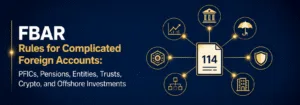
U.S. beneficiaries and trustees with a financial interest in, or signature authority over, foreign accounts held by a non-grantor trust with foreign financial accounts file FinCEN Form 114 (FBAR) when aggregate foreign account values exceed $10,000. Distributions also trigger Form 3520 reporting, separate from FBAR, and both filings carry significant penalty exposure for noncompliance.
Key Takeaways
Foreign non-grantor trusts with U.S. beneficiaries must file FBAR reports by June 30th annually.
U.S. persons creating or transacting with foreign trusts face both income tax and reporting consequences.
Appointing a U.S. agent for the foreign trust minimizes required IRS documentation submissions.
Failure to satisfy foreign trust information reporting requirements results in significant penalties and enforcement action.
- Foreign non-grantor trusts with U.S. beneficiaries must file FBAR reports by June 30th annually.
- U.S. persons creating or transacting with foreign trusts face both income tax and reporting consequences.
- Appointing a U.S. agent for the foreign trust minimizes required IRS documentation submissions.
- Failure to satisfy foreign trust information reporting requirements results in significant penalties and enforcement action.
What Makes a Trust a Foreign Non-Grantor Trust?
Two tests decide whether a trust counts as foreign: a court test and a control test. When a trust fails either one, the IRS treats it as a foreign non-grantor trust rather than a domestic entity, and that changes everything about how it must report to the U.S. government. Failing these tests means the trust is no longer viewed as a U.S. person for tax purposes, even if it holds U.S. assets or serves U.S. beneficiaries.
That classification carries real weight. A foreign non-grantor trust and its U.S. beneficiaries face two compliance tracks: income tax obligations on distributions and earnings, and information reporting requirements that may arise regardless of tax owed. Missing either track exposes the trust and its beneficiaries to penalty risk that has nothing to do with the actual tax bill.
How does a trust fail the U.S. court and control tests?
A trust fails the court test when no U.S. court has primary supervision over its administration. It fails the control test when non-U.S. persons hold authority over substantial trust decisions, such as distributions or investment direction. Either failure alone is enough to trigger foreign trust status.
Trustees and beneficiaries often discover this classification too late. Many clients approach the firm only after realizing they had unfiled FBARs. Other overlooked reporting duties tied to a trust interest they didn’t fully understand. That pattern shows up again and again, particularly among:
Beneficiaries who assumed a family trust was automatically domestic
Trustees managing accounts across multiple jurisdictions
Advisors handling multi-year catch-up filings after the classification issue surfaces
- Beneficiaries who assumed a family trust was automatically domestic
- Trustees managing accounts across multiple jurisdictions
- Advisors handling multi-year catch-up filings after the classification issue surfaces

Does FBAR Reporting Apply to Foreign Trusts?
Yes, but the answer depends on how the trust is classified. Foreign bank account reporting for a non-grantor trust with foreign accounts hinges on one question: is the trust treated as a U.S. person? A trust or estate treated as a U.S. person must file an FBAR whenever it holds a financial interest in, or signature authority over, foreign accounts totaling more than $10,000 at any point during the year. That threshold is measured in aggregate, across every foreign account the trust touches, not per account.
Classification matters enormously here. A foreign trust one that does not meet the tests to be treated as a U.S. person falls outside standard FBAR treatment, but that does not mean the filing obligation disappears entirely.
Does a non-U.S. foreign trust still have reporting duties?
Yes. Foreign trusts not considered U.S. persons still carry reporting responsibilities beyond the FBAR itself. Beneficiaries and trustees connected to these structures often face separate information-return requirements. Skipping the FBAR analysis without checking those additional obligations leaves real exposure on the table.
How do these accounts typically come to the IRS’s attention?
Foreign banks now report American account holders directly to the IRS under FATCA, the Foreign Account Tax Compliance Act. That data-sharing pipeline means the IRS often identifies a trust’s foreign account before the trustee or beneficiary is even aware that a filing was required.
Two scenarios commonly trigger this:
A trustee assumes a foreign entity structure exempts the account from disclosure.
A U.S. beneficiary receives a distribution and never learns the underlying trust held reportable foreign accounts.
- A trustee assumes a foreign entity structure exempts the account from disclosure.
- A U.S. beneficiary receives a distribution and never learns the underlying trust held reportable foreign accounts.
- Either way, discovery by the IRS first, rather than through voluntary disclosure, changes the compliance posture significantly and narrows the available options.

Which Forms Cover Non-Grantor Trust Distributions?
Form 3520 is the primary Form 3520 non grantor trust reporting requirement for a U.S. beneficiary who receives money or property from a foreign non-grantor trust. Missing this filing carries steep penalties, separate from any tax owed on the distribution itself. Beneficiaries, trustees, and cross-border advisors need to know which form applies before a distribution happens, not after — and FBAR filing for trust beneficiaries is a separate obligation that doesn’t go away just because Form 3520 has been handled.
A U.S. beneficiary who receives a distribution from a foreign non-grantor trust must file Form 3520, the annual return that reports transactions with foreign trusts. That obligation applies whether the distribution is cash, securities, or other property, and it exists independent of the form’s separate requirement to report certain foreign gifts received directly. Grantors, owners, and beneficiaries connected to a foreign trust structure generally fall under this same filing requirement, and in some structures a second form, Form 3520-A, applies as well.
The forms serve different purposes:
Does a small distribution still require reporting?
Size does not exempt a distribution from Form 3520 reporting. Even modest transfers from a foreign non-grantor trust can trigger the filing requirement. Skipping it based on dollar amount alone is a common, costly assumption.
Sorting through which forms apply, and in what sequence, depends on the trust’s structure and the beneficiary’s role within it. Ed Parsons CPA reviews these facts directly, drawing on a background in international tax and IRS representation to match each trust, FBAR, and information-return obligation to the client’s actual situation before a filing deadline arrives.
What Penalties Follow Missed Trust Filings?
Missed filings for a foreign non-grantor trust carry two distinct costs: monetary penalties and a longer window for IRS review. Failure to satisfy trust information reporting requirements results in significant penalties. It extends the period the IRS has to assess tax tied to the unreported period. That extension matters. A trustee or beneficiary who assumes an old tax year is closed may find it very much open. The statute of limitations does not run normally when required international forms are missing.
Why does the IRS extend the assessment period for unfiled trust forms?
Congress built this rule to prevent taxpayers from simply outlasting the IRS by staying quiet. Without a complete filing, the IRS cannot verify what happened inside the trust, so the clock on assessment stays open until proper reporting occurs. That single fact turns a paperwork gap into a multi-year exposure problem.
What options exist for trustees who are already behind?
Streamlined Filing Compliance Procedures offer a structured path for non-willful taxpayers. The process requires three years of amended or delinquent tax returns, six years of FBARs, and a signed statement explaining the circumstances behind the missed filings. Taxpayers who qualify under the foreign track pay no penalty on the corrected filings, though eligibility depends on the facts.
Licensed since 2009 — representing clients with international matters such as FBAR, OVDI, Streamlined, since 2009. That background matters when the filing history involves overlapping trust, FBAR, and income tax obligations across several years.
What Should Trustees Do Next?
Trustees should treat every foreign account transaction as a reporting event, not just a tax event. The reporting duty for foreign trust activity applies even when no tax is owed on the transaction itself. Waiting for a tax bill to appear before addressing paperwork rarely improves the outcome. Delay only narrows the options later.
Should trustees handle catch-up filings alone?
Trustees rarely benefit from tackling multi-year filing gaps without guidance. Complex cross-border matters involving non-grantor trusts and foreign accounts often require someone who reviews the full account history personally rather than passing the file between junior preparers. Edward Parsons, CPA works directly from Doral, Florida with trustees and beneficiaries on these filings, giving families and account holders a single, consistent point of contact through the disclosure process.
What if a trust doesn’t qualify for the full Streamlined program?
Not every trust situation fits neatly into the foreign version of the Streamlined Filing Compliance Procedures. Taxpayers who only qualify under the domestic track face a 5 percent penalty on their highest foreign asset balances, a meaningful cost compared to the foreign track. Before assuming which category applies, trustees should map out:
Every foreign account with signature or beneficial authority
Distribution history to U.S. beneficiaries
Prior filed and unfiled information returns
Residency and domicile facts affecting eligibility
- Every foreign account with signature or beneficial authority
- Distribution history to U.S. beneficiaries
- Prior filed and unfiled information returns
- Residency and domicile facts affecting eligibility
- Sorting these facts early prevents costly missteps down the line.
Foreign non-grantor trust FBAR reporting obligations demand precision and consistency year after year. The stakes penalties, audit exposure, and compliance credibility make this an area where systematic documentation and accurate form filing matter profoundly. If your trust holds foreign financial accounts, treating FBAR reporting as a core compliance requirement, not an afterthought, protects both the trust and its beneficiaries. Addressing these obligations directly, with clear recordkeeping and timely filing, keeps your international trust structure on solid legal footing.
FAQ
What makes a trust “foreign” for reporting purposes?
A trust becomes foreign when it fails either the court test or the control test. This happens when no U.S. court supervises administration, or when non-U.S. persons control substantial decisions like distributions or investments.
Who must file FBAR for a foreign non-grantor trust?
U.S. beneficiaries and trustees with a financial interest in, or signature authority over, the trust’s foreign accounts file FinCEN Form 114 when aggregate account values exceed $10,000 at any point during the year. These FinCEN Form 114 trust rules apply regardless of whether the trust itself owes any tax for the year.
Does a distribution from the trust trigger extra filings?
Yes. Distributions trigger Form 3520 reporting, which is separate from FBAR, and both filings carry significant penalty exposure for noncompliance.
Facts
Edward Parsons, CPA is located in Doral, FL, US.
Edward Parsons, CPA has 1 employees.