Skip to content

State refunds routinely take longer than federal refunds because state revenue departments run smaller processing operations, apply aggressive fraud filters, and operate their own offset programs that intercept refunds for state debts. Most states consider several weeks to a few months normal. A delay becomes worth escalating when the state requests nothing and pays nothing well past its published window.
The federal refund arrived weeks ago. The state refund, usually the smaller of the two, is still processing. It feels backwards, and every filing season it sends people searching for an explanation their state refund tracker refuses to give.
The explanation is structural. Here is why the state side runs slower, what quietly intercepts state refunds, and the signals that separate a normal state delay from one that needs escalation.
Why the State Side Runs Slower Than the IRS
- Smaller machines. State revenue departments process a fraction of the volume with a fraction of the systems budget. Batch cycles run less often and manual review queues run longer.
- Heavier fraud screening per return. Identity theft rings target state refunds precisely because state filters historically lagged. Many states now hold large batches of refunds for identity review by default.
- Cross-checking against the federal return. Several states wait on IRS data to verify your federal figures before releasing anything. A slow federal return slows the state one behind it.
- Paper and part-year complexity. Part-year and nonresident returns, credits for taxes paid to other states, and paper filings all route to manual handling.
State Offset Programs: The Interception Nobody Mentions
States run their own version of the federal offset system, and the state list of collectible debts is longer than most filers expect. A state refund can be intercepted for unpaid state taxes from prior years, child support arrears, unemployment overpayments, court fines, tolls, and debts to state agencies and universities.
An intercepted refund often shows as an ordinary delay right up until a reduced payment or an offset letter arrives. If your refund is late and you have any history with a state agency debt, the delay may already be an interception.
State vs Federal Refund: The Comparison
| Factor | Federal Refund (IRS) | State Refund |
| Typical timeline | Most e-filed refunds within 21 days. | Several weeks to a few months, varying widely by state. |
| Visibility | Refund tracker plus a full account transcript with transaction codes. | A status tool only. Almost no state offers transcript-level detail. |
| Fraud screening | Filters applied selectively. | Broad default holds for identity review are common. |
| Offsets | Federal debts, child support, state income tax debts. | State agency debts of many kinds, plus child support. |
| Measurement | Track transcript codes and the code 846 date. | Track your state’s published window. Silence past that window is the escalation signal. |
A Note for Florida Filers
Florida has no state income tax on individuals, so there is no Florida state income tax refund to wait on. If you live in Florida and a refund is late, the refund in question is federal, and the answer lives in your IRS account, not a state system. Filers who moved to Florida mid-year may still have a part-year return, and part-year returns are among the slowest any state processes.
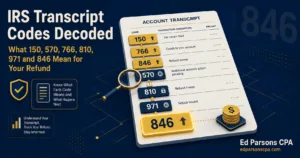
For the federal side, our guide to understanding IRS account transcripts and how to read them shows how to see exactly where a federal refund stands, and our breakdown of transcript codes 150, 806, 766, and 768 covers the codes a healthy refund posts.
How to Check Your State Refund the Right Way
- Use your state revenue department’s own refund tool, not a third-party tracker. The big states publish theirs directly, such as California’s Franchise Tax Board and New York’s Department of Taxation and Finance.
California filers can check status through the FTB refund page, and New York filers through the state refund status page. Every state with an income tax runs an equivalent.
- Find your state’s published processing window on that same site. That window, not the federal 21 days, is your baseline.
- Respond to identity verification requests the day they arrive. State refunds sit frozen until you complete the quiz or upload the documents, and the clock restarts, not resumes.
- Check whether your state waits on federal verification. If it does, a delayed federal refund is the real cause, and the state tracker will never say so.

The Questions Filers Actually Ask
- “My federal refund came weeks ago. Why not the state one?” Different agency, smaller operation, heavier default screening. Weeks of gap between the two is ordinary, not a warning sign.
- “The state tool has said processing for two months.” Check the state’s published window first. If you are inside it, the tool will not change. If you are past it, look for an unanswered verification request before assuming the worst.
- “My state refund came but it was smaller.” Almost always an offset. The explanation letter typically trails the payment, sometimes by weeks.
When a State Delay Is Worth Escalating
- The published window has passed with no payment, no letter, and no verification request.
- The refund arrived visibly short with no offset explanation.
- The state requested documents you already sent, and the status has not moved since.
- The state is holding your refund pending federal figures, and your federal account has its own unresolved hold.
That last pattern is the most common one in practice, and it is a federal problem wearing a state costume. The Personal CPA Tax Resolution Case Analysis pulls your IRS account, identifies the federal condition the state is waiting behind, and maps the response that clears both refunds.
Two Refunds, One Underlying Account
State delays that are purely state-side resolve through the state’s own process: its tool, its verification steps, its taxpayer advocate equivalent. What a state cannot do is release a refund it is holding against unresolved federal data.

At Ed Parsons CPA, IRS account work is the core of the practice, and untangling a federal hold that is quietly stalling a state refund is a routine part of a case analysis. When the federal side clears, the state side usually follows on its own.