Skip to content
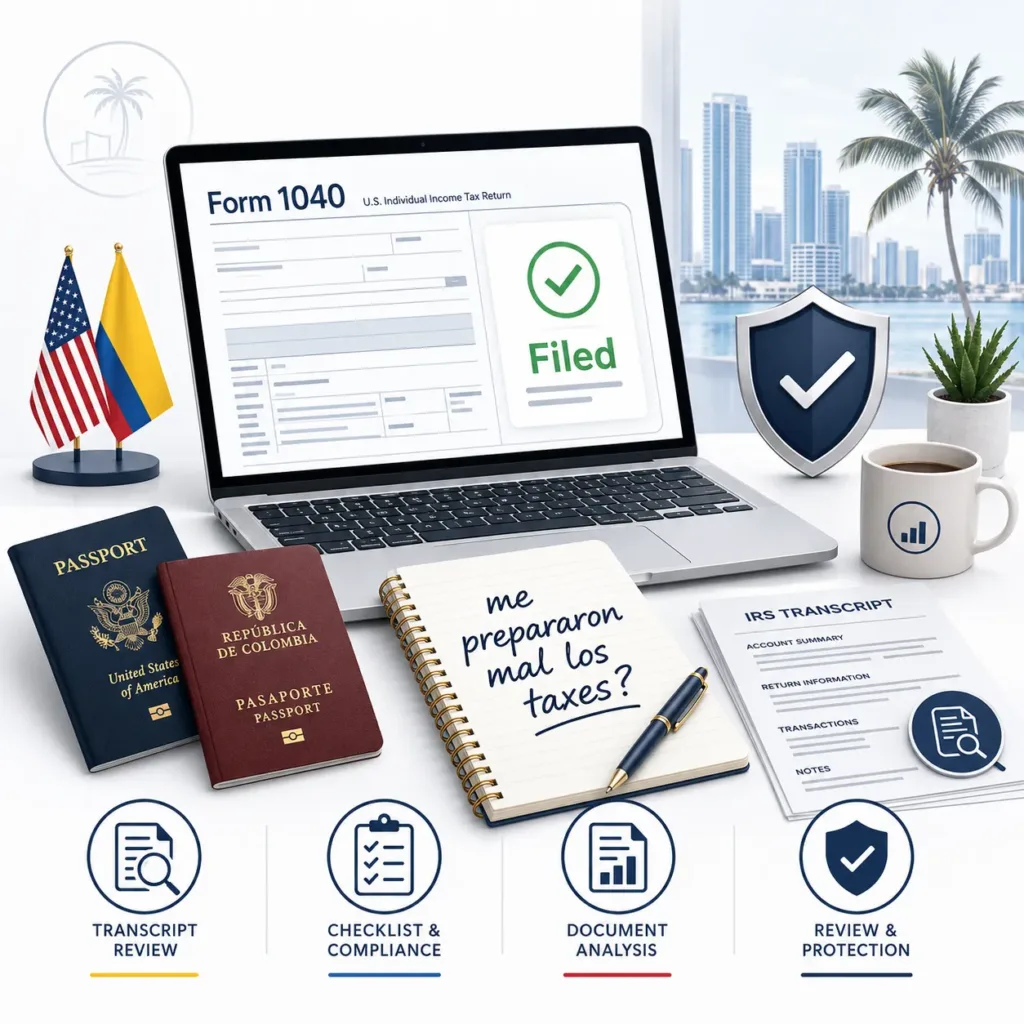
You filed. You paid the preparer. The return was accepted. But now algo feels off.
Maybe your refund seems too low. Maybe it seems too high. Maybe your preparer never asked about Colombia. Maybe you had ingresos de Colombia, cuentas en Colombia, property, rent, pension income, dividends, or taxes paid in Colombia, and now you are wondering whether any of that should have appeared on your U.S. declaración.
This article is for Colombians in Miami, U.S./Colombia dual citizens, green card holders, and U.S. taxpayers with Colombia-related facts who already filed a personal U.S. tax return but are thinking, “me prepararon mal los taxes.”
Tranquilo, first understand what may be wrong.
Quick Answer:
If you think “me prepararon mal los taxes,” do not panic and do not assume the return must be amended immediately. First, identify what may have been missed: Colombian income, foreign taxes paid, Colombian bank accounts, property, IRS transcript activity, refund issues, penalties, or income mismatch clues. A filed return can be accepted by the IRS and still deserve a second look.
Before you amend or assume everything is fine, separate the problem into a few key questions. Did your preparer understand that Colombian income may need to be reported on a U.S. tax return? Did anyone review whether your cuentas en Colombia trigger FBAR or Form 8938 issues? If you paid taxes in Colombia, was the Foreign Tax Credit handled correctly? Once those categories are clear, a CPA review for Colombians in Miami can help you decide whether the issue is a simple correction, a missing form, an amended return, or something that belongs in tax resolution.
First, Do Not Assume the Return Must Be Amended
A bad feeling does not automatically mean your tax return is wrong.
It means the return may deserve a second look.
That distinction matters. Some taxpayers jump straight to “I need to amend.” Others ignore the concern because the IRS accepted the return electronically. Both reactions can be risky.
A filed return can be accepted and still have items worth reviewing. Acceptance does not mean someone carefully reviewed your Colombian income, foreign accounts, foreign tax credits, rental property, or IRS account record. It usually means the return passed basic electronic filing checks and was received.
Before changing anything, the better first step is to identify the issue category:
- Was income missing?
- Were Colombian taxes paid but not considered?
- Were foreign accounts ignored?
- Was the refund calculated incorrectly?
- Is there an IRS transcript issue?
- Is there already an IRS notice, penalty, or balance?
Amending without understanding the IRS-side record can create new problems. The goal is not to react emotionally. The goal is to understand what facts may have been missed and what the IRS record may already show.
Did Your Preparer Ask About Colombia?
For Colombians in Miami, the intake questions matter.
A U.S. tax return can look complete on the surface and still miss Colombia-side facts if nobody asked the right questions. This is especially true when the preparer treats the return like a normal domestic Form 1040 and never asks about foreign income, foreign taxes, foreign accounts, or foreign assets.
Ask yourself:
- Did you have income from Colombia?
- Did you pay taxes in Colombia?
- Did you have Colombian bank accounts?
- Did you own rental property or sell property in Colombia?
- Did you receive pension, dividends, interest, rent, or business income from Colombia?
- Did you have foreign financial assets?
- Did anyone ask about FBAR or Form 8938?
- Did anyone ask whether Form 1116 foreign tax credit applied?
If those questions were never asked, the issue may not be the math. The issue may be missing facts.
For U.S. citizens and resident aliens, the IRS states that worldwide income from all sources is generally subject to U.S. reporting and tax rules, whether the taxpayer is in the United States or abroad. That is why Colombian income on a U.S. tax return can matter even when the money stayed in Colombia.
Internal link: Colombian income on a U.S. tax return
Common Colombia-Related Items That Get Missed
Colombian Income
Colombian income can include wages, self-employment income, pension income, dividends, interest, rental income, business income, or gains from selling property.
A common mistake is assuming that income does not matter for U.S. tax purposes because it was earned in Colombia, deposited in Colombia, or taxed in Colombia. That assumption can be wrong.
The question is not just “Did I pay Colombian tax?” The question is whether the income was properly reported on the U.S. return and whether any U.S. foreign tax credit, exclusion, deduction, or reporting form was considered correctly.
Colombian Bank Accounts
Colombian accounts can raise reporting questions even when the account did not produce much income.
For example, a Colombian savings account, checking account, investment account, or certain other financial account may create a separate FBAR question. FinCEN says a United States person with a financial interest in, or signature authority over, foreign financial accounts must file an FBAR when the aggregate value of foreign financial accounts exceeds $10,000 at any time during the calendar year.
That is separate from whether the account produced taxable income.
Internal link: FBAR vs Form 8938 for Colombian Accounts
Foreign Taxes Paid in Colombia
Paying tax in Colombia does not automatically mean the U.S. return handled the issue correctly.
Some taxpayers may be eligible for a foreign tax credit, but the credit depends on the type of tax, the type of income, the amount paid or accrued, and how the return was prepared. The IRS says individuals generally use Form 1116 to claim a foreign tax credit for certain foreign taxes paid or accrued to a foreign country or U.S. possession.
A missed foreign tax credit can affect the refund. A wrong foreign tax credit can create risk. The goal is not just to claim something. The goal is to claim it correctly.
Internal link: Foreign Tax Credit Mistakes for Colombians Filing U.S. Returns
Colombian Property or Rental Income
If you owned rental property in Colombia, sold property in Colombia, or received income connected to Colombian real estate, the U.S. return may need a closer look.
This does not mean every property fact creates the same tax result. It means the facts matter. Rental income, expenses, depreciation, foreign taxes, sale proceeds, exchange rates, and ownership structure can all affect the analysis.
Internal link: Colombian Property, Rental Income, and U.S. Tax Return Risk
Colombian Pensions and Pension Voluntaria Accounts
Colombian pension facts can be easy to overlook because many taxpayers do not think of a pensión obligatoria, pension voluntaria, or retirement-style account as part of their U.S. tax return. But for U.S. citizens and resident aliens, the U.S. tax system generally starts from worldwide income, which means Colombia-side retirement income, pension distributions, investment income, and certain account values may need to be reviewed even if the money stayed in Colombia. The IRS also notes that income received from foreign pensions or annuities may be fully or partly taxable, even when no Form 1099 is issued.
A pension voluntaria can also raise a separate reporting question. The issue is not only whether money came out of the pension. The account’s value, growth, underlying investments, and whether the taxpayer has a reportable interest in a foreign financial account or specified foreign financial asset may matter. Some taxpayers may need to evaluate whether the pension or related account belongs on FBAR, Form 8938, or both. FinCEN says FBAR generally applies when a U.S. person has a financial interest in or signature authority over foreign financial accounts and the aggregate value exceeds $10,000 at any time during the year. Form 8938 is a separate IRS reporting form for specified foreign financial assets when the taxpayer exceeds the applicable reporting threshold, and the IRS explains that filing Form 8938 does not replace a separate FBAR requirement.
The technical point is this: Colombian pension reporting is not always solved by asking, “Did I receive a distribution?” A proper review may need to ask whether there were contributions, employer amounts, personal voluntary contributions, account growth, taxable distributions, foreign tax paid, FBAR exposure, Form 8938 exposure, or investment assets inside the pension that create additional U.S. reporting concerns. This is one reason a return can look normal but still deserve a second look when the preparer never asked about pensiones, pension voluntaria, or retirement accounts in Colombia.
Refunds That Look Too Low or Too High
A wrong refund can go in either direction.
A refund that looks too low may suggest missed credits, payments, withholding, foreign tax credit issues, or other items that were not handled correctly.
A refund that looks too high can also be a risk if income, forms, accounts, or assets were omitted.
The goal is not simply a bigger refund. The goal is a correct and defensible return.
Why an Accepted Return Can Still Leave Questions
IRS acceptance is not the same as a full review. When a return is electronically accepted, that usually means the return passed basic filing checks and was received by the IRS. It does not mean the IRS verified every Colombia-related fact, confirmed every income source, reviewed every foreign account issue, or approved every credit. A return can be accepted and still have missed income, incorrect refund treatment, foreign account reporting gaps, or transcript activity that deserves a second look.
There is also a timing issue. The IRS generally has a limited period to assess additional tax, often three years from when the return was due or filed, depending on the facts. Refund claims also have time limits, commonly three years from filing the original return or two years from paying the tax, whichever is later. But certain facts can change the analysis, including missing returns, fraud, major omissions, or other special situations. That is why “me prepararon mal los taxes” should not be ignored, especially if Colombian income, cuentas en Colombia, pension accounts, property, or foreign tax credits were never discussed.
Another issue is who prepared the return. The IRS warns taxpayers to avoid “ghost preparers” who prepare returns but refuse to sign them or include a valid Preparer Tax Identification Number. Paid preparers are generally required to have a valid PTIN, and the IRS says a preparer who refuses to sign or provide a PTIN is a major red flag. This matters because the taxpayer is still legally responsible for what is filed, even when someone else prepared the return.
That does not mean every preparer mistake is the taxpayer’s fault in a practical sense. Sometimes the preparer failed to ask the right questions. Sometimes the taxpayer did not realize Colombian facts mattered. Sometimes the intake process was too basic for an international or cross-border situation. But once the taxpayer signs the return, the IRS generally looks to the taxpayer first for the accuracy of the filing, the tax owed, and any penalties that may apply.
This is one reason working with a CPA can matter, especially when the return involves Colombia-side facts. CPAs have unlimited representation rights before the IRS, meaning they can represent taxpayers in audits, payment issues, collection matters, and appeals. CPAs are also subject to professional conduct rules under Circular 230 when practicing before the IRS, including standards involving competence, diligence, and professional responsibility.
A CPA review also helps create a better record if penalties become an issue. Reasonable cause penalty relief is not automatic, and hiring a CPA does not guarantee penalty removal. But the IRS considers whether the taxpayer exercised ordinary care and prudence based on the facts and circumstances. A documented CPA-led review can help show that the taxpayer took the issue seriously, gathered records, reviewed the IRS-side account, and tried to correct or understand the problem instead of ignoring it.
Before assuming the return is fine or wrong, it may help to understand what the IRS record shows. Your copy of the return is only one side of the picture. IRS transcripts may show refund activity, payments, balances, penalties, missing filings, wage and income records, or mismatch clues that are not obvious from the PDF your preparer gave you. That is why an accepted return can still deserve a careful review, especially when the preparer never asked about Colombia.
What to Check Before You Blame the Preparer
Sometimes a preparer made a mistake. Sometimes the taxpayer did not realize the Colombia-side facts mattered. Sometimes the issue only becomes clear after reviewing IRS records.
Before blaming anyone, check the facts:
- Did the preparer ask about Colombia?
- Did the return include all income sources?
- Was foreign tax paid in Colombia considered?
- Were Colombian accounts discussed?
- Were FBAR or Form 8938 questions addressed?
- Was rental property or property sale activity discussed?
- Does the refund make sense compared with your income, withholding, credits, and foreign tax paid?
- Do IRS transcripts show balances, penalties, missing filings, or income mismatch clues?
Form 8938 is another area where confusion is common. The IRS says Form 8938 is used to report specified foreign financial assets when the total value exceeds the appropriate reporting threshold. The IRS also explains that Form 8938 does not replace the separate FBAR requirement, and taxpayers may need to check whether one or both forms apply.
That is why “my preparer never asked about cuentas en Colombia” can be a legitimate concern.
When This Is a Review Issue vs a Tax Resolution Problem
| This may be a review issue if: | This may already be a tax resolution issue if: |
|---|---|
| You are unsure whether anything is wrong | You received an IRS notice |
| You want to check refund or risk indicators | You owe a balance |
| You have Colombia-related facts that may not have been reviewed | You have penalties |
| You do not have an active IRS notice | You have unfiled returns |
| You want to understand the IRS-side record first | You have collection activity |
| You have a lien, levy, audit, or CP2000-style issue |
If you are still in the “algo feels off” stage, this may be a review issue. You are trying to understand whether the filed return, refund, foreign income, foreign accounts, or IRS record deserves a closer look.
If you already know there is an IRS problem, a deeper tax resolution case analysis may be more appropriate than a basic refund and risk review.
The difference matters because the right next step depends on the problem. A refund concern, missing Colombian income concern, or transcript mismatch concern is not the same as an active IRS collection case.
The Safer Next Step: Understand the IRS-Side Record
A good next step is not panic, blame, or guessing. A better next step is to understand what IRS records show and which issue category applies.
If you are still in the ‘algo feels off’ stage, the next article to read is How IRS Transcripts Can Reveal Refunds, Penalties, and Filing Problems. It explains how IRS account and wage records can show filing gaps, refund indicators, penalty activity, income mismatch clues, and other risks that may not appear clearly on your copy of the return.
Internal link: How IRS Transcripts Can Reveal Refunds, Penalties, and Filing Problems
Not sure what your IRS record shows? Start by learning how an IRS transcript review can reveal filing gaps, refund indicators, income mismatch clues, penalties, and other risk signals.
Edward Parsons CPA also offers a CPA-led Tax Refund & Risk Assessment for personal tax situations, but this article is not asking you to jump straight into a paid review. First, understand what category of issue you may have and whether the IRS-side record helps explain the concern.