Skip to content
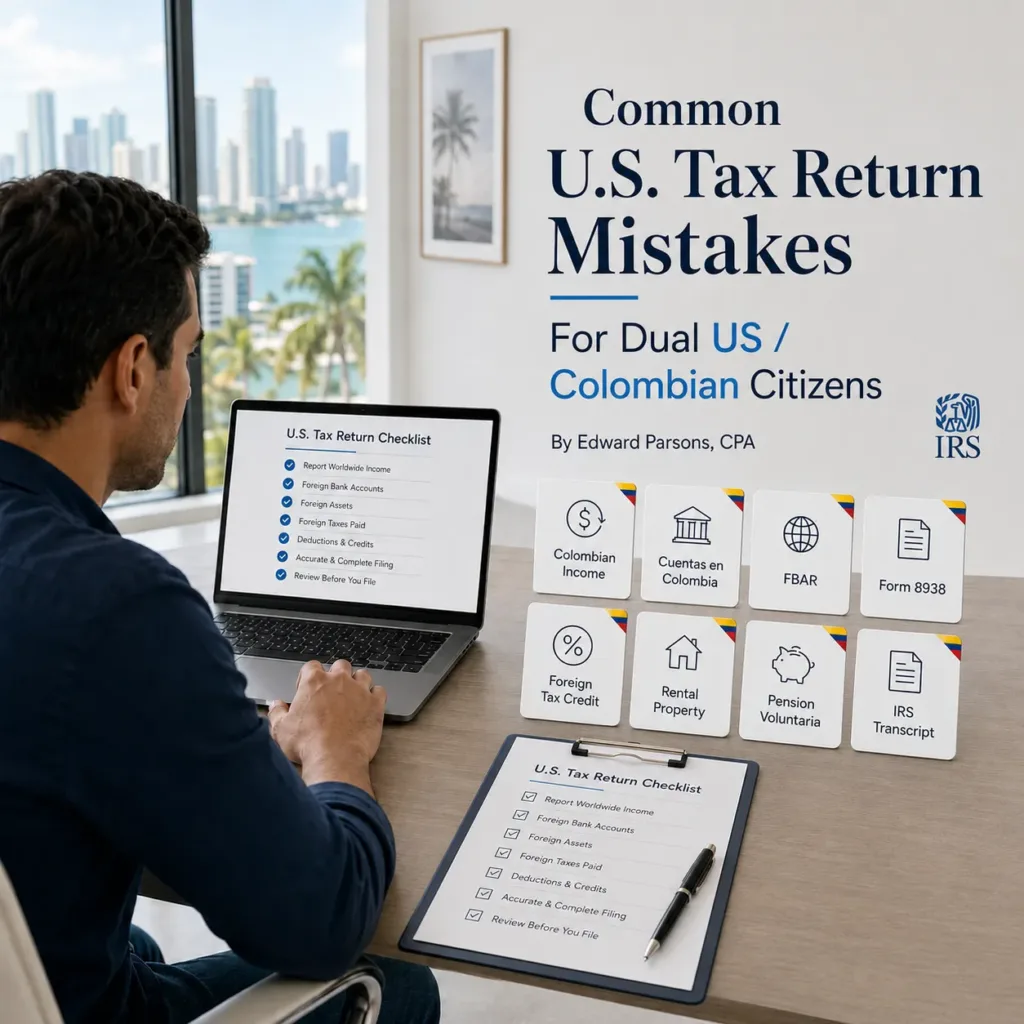
You filed your U.S. taxes. Maybe you got a refund. Maybe the return was accepted. Maybe your preparer said everything was fine.
But now you are wondering: Did my U.S. tax return really handle my Colombia-side facts correctly?
For Colombian taxpayers in Miami, the most common tax return mistakes are not always obvious. Sometimes the return looks normal. The refund arrives. There is no IRS notice yet. But the preparer never asked about ingresos de Colombia, cuentas en Colombia, Colombian taxes paid, Colombian property, pension voluntaria, or whether FBAR or Form 8938 applied.
That is where problems can start.
This article explains common mistakes Colombian taxpayers in Miami should watch for after filing a U.S. personal tax return. It is not a reason to panic, and it is not saying every return with Colombia facts is wrong. The goal is to help you recognize what may deserve a second look.
If your concern is more general and you are thinking, “me prepararon mal los taxes,” start with this related article first: Me Prepararon Mal Los Taxes? What Colombianos en Miami Should Check First.
Quick Answer:
Common U.S. tax return mistakes for Colombian taxpayers in Miami include failing to report Colombian income, ignoring Colombian bank accounts, missing FBAR or Form 8938 questions, not reviewing foreign tax credits for Colombian taxes paid, overlooking Colombian property or rental income, ignoring pensions or pension voluntaria accounts, relying only on IRS transcripts, and assuming an accepted return means everything was fully reviewed.
I think mistake 11 is the most common and most expensive one, when you Own a Colombian Company, CFC Rules May Affect Your U.S. Tax Return
Mistake 1: Assuming Colombian Income Does Not Count
The biggest mistake is assuming Colombian income does not belong on a U.S. tax return.
For U.S. citizens and resident aliens, the IRS says worldwide income from all sources generally must be reported, whether the taxpayer is in the United States or abroad. IRS Publication 54 also explains that U.S. citizens and resident aliens living and working abroad are taxed on worldwide income, although certain exclusions or deductions may apply depending on the facts.
For Colombians in Miami, this can include:
- Salary or wages from Colombia
- Independent contractor income
- Business income
- Rental income from Colombian property
- Colombian pension income
- Interest or dividends
- Capital gains from selling Colombian property or investments
- Income from a Colombian business or family arrangement
The issue is not only whether the income was taxed by DIAN. The U.S. return may still need to report it and then evaluate whether a foreign tax credit, exclusion, deduction, or other treatment applies.
For a deeper explanation, read: Do Colombians in Miami Need to Report Colombian Income on U.S. Taxes?.
Mistake 2: Thinking “I Paid Tax in Colombia” Ends the U.S. Issue
Paying tax in Colombia does not automatically mean the U.S. return is complete.
Many taxpayers assume, “Ya pagué en Colombia, so I do not need to report it here.” That can be wrong.
The U.S. return may still need to report the income. Then the preparer may need to review whether a foreign tax credit applies. The IRS explains that the foreign tax credit may apply to certain foreign taxes paid or accrued to a foreign country or U.S. possession, subject to rules and limits.
Common mistakes include:
- The Colombian income was not reported at all
- Colombian taxes paid were ignored
- Form 1116 was missing
- The foreign tax credit was calculated incorrectly
- The taxpayer claimed something without documentation
- The preparer treated Colombian tax as irrelevant
The goal is not just to reduce U.S. tax. The goal is to report the income correctly and use the proper credit or deduction only when supported.
Related education article: Foreign Tax Credit Mistakes for Colombians Filing U.S. Returns.
Mistake 3: Ignoring Cuentas en Colombia
A Colombian bank account can matter even if it produced little or no income.
This is where many taxpayers get surprised. They think the account is only relevant if it paid interest. But FBAR is about foreign financial accounts and account values, not only taxable income.
FinCEN says a United States person with a financial interest in, or signature authority over, foreign financial accounts must file an FBAR if the aggregate value of foreign financial accounts exceeds $10,000 at any time during the calendar year.
Examples may include:
- Colombian checking accounts
- Colombian savings accounts
- Investment accounts
- Brokerage accounts
- Accounts where you had signature authority
- Certain retirement-style or pension-related accounts depending on facts
A return can be mathematically correct and still have a foreign account reporting issue. That is why “my preparer never asked about cuentas en Colombia” is a legitimate red flag.
Related education article: FBAR vs Form 8938 for Colombian Accounts.
Mistake 4: Confusing FBAR and Form 8938
FBAR and Form 8938 are not the same thing.
FBAR is filed with FinCEN and generally focuses on foreign financial accounts. Form 8938 is filed with the IRS and reports specified foreign financial assets when the taxpayer exceeds the applicable reporting threshold. The IRS says Form 8938 is used to report specified foreign financial assets if the total value exceeds the appropriate threshold.
The IRS also provides a comparison of Form 8938 and FBAR requirements, showing that the forms are separate and may apply differently depending on the taxpayer and assets.
A common mistake is assuming:
- “I filed FBAR, so I do not need Form 8938.”
- “I filed Form 8938, so I do not need FBAR.”
- “The account is in Colombia, so the IRS will not care.”
- “The account did not earn income, so nothing is required.”
Those assumptions can be risky.
The right question is whether either form applies based on the account, asset, value, ownership, filing status, and taxpayer facts.
Mistake 5: Overlooking Colombian Property or Rental Income
Colombian property can create U.S. tax issues.
This includes rental property, Airbnb or short-term rental income, property sales, and possibly income connected to real estate held through a company or family arrangement.
Common mistakes include:
- Not reporting Colombian rental income
- Ignoring expenses and depreciation
- Forgetting foreign taxes paid
- Not reporting a property sale
- Treating Colombian pesos as if no currency conversion issue exists
- Assuming property outside the U.S. does not belong on a U.S. return
If you are a U.S. citizen or resident alien, the worldwide income rule may apply even when the property is outside the United States. The tax result depends on the facts, but the property should not be ignored.
Related education article: Colombian Property, Rental Income, and U.S. Tax Return Risk.
Mistake 6: Ignoring Pensiones and Pension Voluntaria Accounts
Colombian pension issues are often missed because taxpayers do not think of a pensión obligatoria, pension voluntaria, or retirement-style account as part of U.S. tax reporting.
But the account may need review.
Potential issues include:
- Pension distributions
- Pension income
- Employee or voluntary contributions
- Employer contributions
- Growth inside the account
- Underlying investments
- Foreign taxes paid
- FBAR questions
- Form 8938 questions
The IRS has guidance on the taxation of foreign pension and annuity distributions, and the treatment may depend on the facts. The awareness-level point is simple: if nobody asked about your Colombian pension or pension voluntaria, the return may deserve review.
This is especially important when the account value is significant or when the taxpayer also has Colombian bank or investment accounts.
Mistake 7: Relying Only on IRS Wage and Income Transcripts
IRS transcripts are useful, but they do not show everything.
The IRS says taxpayers can access tax records and transcripts, including past tax return transcripts, tax account information, wage and income statements, and verification of non-filing letters. The IRS also explains that a wage and income transcript shows data reported to the IRS on information returns such as Forms W-2, Forms 1099, Forms 1098, and Forms 5498.
That is useful for U.S.-reported income. But it may not show Colombian income if no U.S. payer reported it to the IRS.
So if someone says, “The transcript looks clean,” that does not automatically mean Colombian income, Colombian accounts, pension voluntaria, or Colombian property were handled correctly.
The transcript is one layer. The Colombia-side facts are another layer.
Related education article: How IRS Transcripts Can Reveal Refunds, Penalties, and Filing Problems.
Mistake 8: Assuming a Bigger Refund Is Always Good
A bigger refund can feel like a win, but it is not always safer.
A refund that is too high may indicate that income was omitted, credits were claimed incorrectly, withholding or payments were misapplied, or foreign items were not handled correctly.
For Colombian taxpayers in Miami, this can happen when:
- Colombian income was left off the return
- A foreign tax credit was claimed incorrectly
- Dependents or credits were not supported
- Business expenses were inflated
- The preparer did not ask about foreign accounts
- The taxpayer signed a return they did not fully understand
A refund should be correct and defensible. Not just bigger.
If you already filed and your refund feels wrong, read: Me Prepararon Mal Los Taxes? What Colombianos en Miami Should Check First.
Mistake 9: Using a Preparer Who Does Not Sign the Return
The IRS warns taxpayers about “ghost preparers,” meaning preparers who prepare returns but do not sign them or include a valid Preparer Tax Identification Number. The IRS says anyone can be a paid tax return preparer as long as they have a PTIN, but preparers have different levels of skill, education, and expertise.
For Colombia-connected returns, this matters because the return may require more than basic data entry.
A preparer should ask about:
- Colombian income
- Colombian bank accounts
- Foreign tax paid
- Colombian property
- Colombian pensions
- Foreign financial assets
- FBAR and Form 8938
- Prior-year issues
- IRS notices or transcripts
If your preparer did not sign the return, did not include a PTIN, or told you to file as if you prepared it yourself, that is a serious warning sign.
Mistake 10: Amending Too Fast Without Understanding the IRS Record
If you discover a possible mistake, your first instinct may be: “I need to amend.”
Maybe. But not always immediately.
The IRS provides guidance for filing an amended return, but an amendment should be based on a clear understanding of what was wrong and what needs to change. Amending without first reviewing the filed return, IRS transcripts, income records, Colombian facts, foreign tax credits, and account reporting issues can create confusion.
Before amending, ask:
- What exactly was missed?
- Was the income omitted?
- Was the credit wrong?
- Was a form missing?
- Does the IRS transcript show a balance, penalty, refund, or mismatch?
- Was this personal, business, or both?
- Is there already an IRS notice?
If the concern is still unclear, an IRS transcript review article is a better next step than guessing.
Mistake 11: Treating a Business Issue Like a Personal Return Issue
Some Colombian taxpayers in Miami also own businesses.
That creates a routing problem. A personal Form 1040 concern is different from a business IRS account issue.
For example:
- A Colombian business may need a separate tax return with the IRS.
- A personal refund concern may belong with a personal return review.
- A Colombian income concern may belong on the personal side.
- An LLC, corporation, S corporation, or partnership concern may need business review.
- Payroll tax deposits, Form 941 issues, business penalties, and business IRS transcripts are not the same as a personal Form 1040 issue.
If your concern involves a business, do not assume the personal review is enough.
A Colombian Business Can Create a Separate U.S. Reporting Problem
For dual U.S./Colombian taxpayers, a business issue is not always limited to reporting income on Form 1040. A Colombian SAS, S.A., LTDA, family company, real estate company, professional company, operating business, branch, investment vehicle, or partnership-type arrangement may need a separate U.S. tax classification review before anyone can know which forms apply.
This is where many mistakes happen. A taxpayer may say, “The company is in Colombia,” or “DIAN already has the business filing,” and assume the U.S. return only needs to report salary, dividends, or distributions. But the IRS may care about the structure itself, not just whether cash came out of the company. Own a Colombian Company? CFC Rules May Affect Your U.S. Tax Return
Depending on the facts, a foreign business may be treated in several different ways for U.S. tax purposes:
- Foreign disregarded entity or foreign branch: A business owned by one U.S. taxpayer, or an entity treated as ignored from its owner for U.S. tax purposes, may create Form 8858 issues. This can come up when the business activity is not a separate foreign corporation for U.S. purposes, but still needs international reporting.
- Controlled Foreign Corporation (CFC): A Colombian corporation, including a Colombian SAS or S.A. in the right ownership facts, may create Form 5471 issues if U.S. ownership or control rules are triggered. This can matter even when no dividend was paid.
- Per se corporation: Some foreign legal entities may be treated as corporations automatically for U.S. tax purposes. In those cases, the taxpayer may not be able to simply choose partnership or disregarded entity treatment because it feels simpler.
- PFIC: A Colombian investment fund, holding company, or pooled investment structure may need PFIC review if the assets or income are investment-heavy. PFIC issues usually point toward Form 8621, not Form 5471.
- Foreign partnership: If the Colombian business is treated as a partnership for U.S. tax purposes, the issue may involve Form 8865, K-1-style reporting, ownership changes, transfers, or foreign partnership reporting rules.
The main point is that “I own a Colombian business” is not one tax category. The U.S. treatment depends on the legal entity, ownership percentages, elections, control, income type, assets, books, distributions, and whether the entity is classified as a corporation, partnership, disregarded entity, branch, PFIC, or something else for U.S. tax purposes.
This also means FBAR and Form 8938 are not enough by themselves. Those forms may report foreign accounts or foreign financial assets, but they do not necessarily solve the entity classification question. A Colombian company can create a Form 5471, Form 8858, Form 8621, or Form 8865 issue even when the taxpayer already reported Colombian bank accounts.
If the issue is a Colombian corporation or possible CFC, start with this education article: IRS Reclassified Your Foreign Company as a CFC? Streamlined Filing May Help Reduce the Damage.
If the issue is already clearly form-specific, start with the relevant guide:
- Form 5471 for foreign corporations and CFCs
- Form 8858 for foreign disregarded entities and branches
- Form 8621 and the PFIC rules
- Form 8865 for foreign partnerships and K-1 reporting
- Form 8832 entity classification election
The safer approach is to classify the Colombian business first, then decide which U.S. forms belong on the return. Guessing the form based only on the Colombian entity name can create missed filings, duplicate reporting, or the wrong U.S. tax treatment.
For personal return concerns, the starting point is an IRS transcript-based review of refund opportunities, penalties, filing issues, and personal tax risks, which is what a CPA can find in your IRS transcripts walks through.
For business concerns, the equivalent review is built around business IRS transcript history, payroll tax concerns, filing gaps, and business tax risks.
Mistake 12: Not Separating Review Issues From Tax Resolution Problems
Not every mistake means you have a tax resolution case.
This may be a review issue if:
- You are unsure whether anything is wrong
- You suspect Colombian income, accounts, or taxes were missed
- Your refund seems wrong
- Your preparer never asked about Colombia
- You do not have an active IRS notice
- You want to understand the IRS-side record first
This may already be a tax resolution issue if:
- You received an IRS notice
- You owe a balance
- You have penalties
- You have unfiled returns
- You have a lien, levy, audit, or collection issue
- You received a CP2000-style mismatch notice
The IRS explains that a CP2000 notice is issued when information reported to the IRS by third parties does not match what was reported on the return. If you already have an IRS notice, balance, penalty, lien, levy, or audit, the better route is a full tax resolution analysis, not a basic refund and risk review.
The Safer Next Step
If you are a Colombian taxpayer in Miami and your return may have missed Colombia-side facts, do not panic and do not guess.
Start by identifying the mistake category:
- Colombian income
- Colombian bank accounts
- FBAR or Form 8938
- Foreign tax credit
- Colombian property
- Pension or pension voluntaria
- IRS transcript issue
- Refund concern
- Prior preparer concern
- Business vs personal issue
- Known IRS notice or tax resolution problem
Then move deeper into the cluster:
- Do Colombians in Miami Need to Report Colombian Income on U.S. Taxes?
- Me Prepararon Mal Los Taxes? What Colombianos en Miami Should Check First
- How IRS Transcripts Can Reveal Refunds, Penalties, and Filing Problems
- FBAR vs Form 8938 for Colombian Accounts
- Foreign Tax Credit Mistakes for Colombians Filing U.S. Returns
- Colombian Property, Rental Income, and U.S. Tax Return Risk
- CPA Tax Return Review for Colombians in Miami
The goal is not to blame the preparer immediately. The goal is to understand what may have been missed, what the IRS record shows, and whether the issue is review, amendment, business review, or tax resolution.
Common Tax Mistakes Colombians in Miami Ask About
These FAQs help Colombian taxpayers in Miami understand common U.S. return mistakes before they amend, ignore the issue, or assume everything is fine.
What is the most common U.S. tax mistake Colombian taxpayers in Miami make?
One of the most common mistakes is assuming Colombian income does not belong on a U.S. tax return. U.S. citizens and resident aliens generally report worldwide income, including income from Colombia.
For more detail, read Do Colombians in Miami Need to Report Colombian Income on U.S. Taxes? .
Official source: IRS worldwide income guidance
Is paying tax in Colombia enough to avoid reporting the income in the U.S.?
No. Paying tax in Colombia does not automatically remove the U.S. reporting requirement. The U.S. return may still need to report the income and then review whether a foreign tax credit applies.
Read Foreign Tax Credit Mistakes for Colombian Taxes Paid for the next education step.
Official source: IRS foreign tax credit guidance
Do Colombian bank accounts matter if they did not earn interest?
They may. Colombian bank accounts can raise FBAR or Form 8938 reporting questions even when the account produced little or no income. Account value and ownership can matter.
Read FBAR vs Form 8938 for Colombian Accounts if your preparer never asked about cuentas en Colombia.
Official source: FinCEN FBAR guidance
What is the mistake with FBAR and Form 8938?
The mistake is assuming FBAR and Form 8938 are the same. They are separate reporting rules, with different filing systems, thresholds, and asset definitions. Some taxpayers may need one, both, or neither.
Start with FBAR vs Form 8938 for Colombian Accounts .
Official source: IRS comparison of Form 8938 and FBAR
Can Colombian rental property create a U.S. tax mistake?
Yes. Rental income, property expenses, depreciation, Colombian taxes paid, currency conversion, and property sales may all require review on a U.S. return depending on the facts.
Read Colombian Property, Rental Income, and U.S. Tax Return Risk for the related education article.
Official source: IRS Publication 54
Does pension voluntaria need to be reviewed?
Yes, it should be reviewed. A Colombian pension voluntaria or retirement-style account may raise income tax, FBAR, Form 8938, foreign tax credit, or investment reporting questions depending on the facts.
If your preparer never asked about Colombian pension accounts, consider reading ¿Tus Taxes No Cuadran? CPA Review para Colombianos en Miami after the education articles.
Official source: IRS foreign pension and annuity guidance
Can IRS transcripts show these Colombia-related mistakes?
IRS transcripts can show filing history, refund activity, payments, penalties, balances, wage and income records, and mismatch clues. But they may not show Colombian income or accounts if no U.S. payer reported them.
Read How IRS Transcripts Reveal Refunds, Penalties, and Filing Issues .
Official source: IRS Get Transcript
Is a bigger refund always better?
No. A bigger refund may feel good, but it can be risky if income was omitted, credits were claimed incorrectly, foreign accounts were ignored, or the return is not defensible.
If your refund feels wrong, start with Me Prepararon Mal Los Taxes? What Colombianos en Miami Should Check First .
Official source: IRS CP2000 mismatch notice guidance
Should I amend my return if I find one of these mistakes?
Not automatically. First identify what was missed, whether IRS transcripts show related activity, whether foreign account reporting applies, and whether the issue is personal, business, or already an IRS resolution problem.
If you are unsure what the IRS record shows, read How IRS Transcripts Reveal Refunds, Penalties, and Filing Issues .
Official source: IRS amended return guidance
When should I use a personal review, business review, or tax resolution analysis?
Use a personal review when the concern is your Form 1040, refund, Colombian income, Colombian accounts, foreign tax credit, property, pension, or personal IRS transcript. Use a business review when the issue involves an LLC, corporation, partnership, payroll, business penalties, or business IRS account. Use tax resolution analysis when there is already an IRS notice, balance, penalty, lien, levy, audit, or collection problem.
Personal route: what a CPA can find in your IRS transcripts. Business route: a business transcript review. Known IRS problem route: a full tax resolution analysis.
Official source: IRS choosing a tax professional