Skip to content

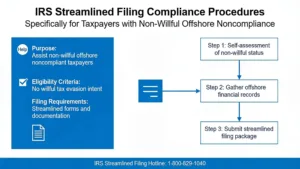
The Streamlined Filing Compliance Procedures are an IRS program for taxpayers whose failure to report foreign income, accounts, or assets was non-willful. You file three years of tax returns, six years of FBARs, and a signed certification explaining your conduct. Taxpayers who qualify under the foreign track pay no penalty. Taxpayers under the domestic track pay a 5 percent penalty on their highest foreign asset balances.
People usually land on this page asking some version of these questions:
“I just found out about FBAR. Can I fix past years without getting destroyed by penalties?”
“Is the IRS streamlined program a real amnesty or a trap?”
“Do I use the domestic or the foreign version if I recently moved back to the U.S.?”
Why the IRS Created a Path Back Into Compliance?
Foreign banks now report American account holders directly to the IRS under FATCA. The government often knows about an account before the taxpayer realizes a filing was required.
The streamlined procedures give non-willful taxpayers a defined route out. Instead of penalty exposure across every open year, the program limits the cleanup to a fixed lookback period and caps or eliminates the penalties that would otherwise stack up.
The IRS has kept the program open for over a decade, but it has also stated that the procedures can end at any time without advance notice. That single fact drives most of the urgency around filing sooner rather than later.
Who Qualifies
Eligibility is narrower than most people assume. The program covers individual taxpayers and estates, and every requirement below must be met.
- Your failure to report income, pay tax, and file information returns must have been non-willful. That means negligence, inadvertence, mistake, or a good faith misunderstanding of the law.
- You need a valid Taxpayer Identification Number, which for most filers means a Social Security Number.
- You cannot use the program once the IRS opens a civil examination of any tax year, even one unrelated to foreign assets.
- A taxpayer under criminal investigation is excluded entirely.
- Penalties the IRS has already assessed for prior years are not refunded or abated by a streamlined submission.
Willfulness is the line that decides everything. Taxpayers who knowingly hid accounts belong in the Voluntary Disclosure Practice instead, and walking through the wrong door has real consequences.
The Two Tracks: Domestic and Foreign
The program splits into the Streamlined Domestic Offshore Procedures (SDOP) and the Streamlined Foreign Offshore Procedures (SFOP). The dividing line is a residency test, and it is stricter than it sounds. Our breakdown of the domestic vs foreign streamlined programs walks through the traps in detail.
| Factor | Streamlined Domestic (SDOP) | Streamlined Foreign (SFOP) |
| Measurement | 5% penalty on the highest year end value of foreign financial assets | Zero penalty |
| Who it covers | Taxpayers who do not meet the non-residency test | Taxpayers with no U.S. abode and 330 full days abroad in at least one covered year |
| Returns filed | Amended returns only, for the three most recent years | Original or amended returns for the three most recent years |
| Certification form | Form 14654 | Form 14653 |
| FBARs | Six years of delinquent FBARs | Six years of delinquent FBARs |
| Red ink label | Streamlined Domestic Offshore | Streamlined Foreign Offshore |
The 5 percent domestic penalty applies to the highest year end value of all foreign financial assets across the covered period, not just bank accounts. How the 5 percent SDOP penalty is actually calculated surprises almost everyone, because pensions, insurance policies, and entity held assets can all land in the base.
What a Complete Submission Includes
Both tracks require the same core package: three years of tax returns reporting all worldwide income, six years of FBARs filed electronically through the FinCEN system, and payment of the tax and interest due. The IRS domestic track instructions spell out each element.
SFOP filers can submit original returns if they never filed at all. SDOP filers can only amend returns that were filed on time, which is one of the most common eligibility surprises.
The returns must also carry every required international information return. That includes Form 8938 for foreign financial assets, Form 3520 for foreign trust distributions and large gifts, Form 3520-A for foreign trusts with a U.S. owner, and Form 8621 for PFIC investments such as foreign mutual funds.
Every page of the submission is labeled in red ink with the program name so the IRS routes it correctly. A package with missing pieces is not treated gently.
The Certification Decides the Outcome
Every submission stands on a signed certification. SFOP filers use Form 14653 and SDOP filers use Form 14654, both signed under penalty of perjury.
The certification carries a narrative explaining why your noncompliance was non-willful, and the IRS reads it as a sworn statement of fact. A weak Form 14653 narrative can undo an otherwise perfect submission, and Form 14654 mistakes compound the risk because the penalty calculation is baked into the same document.
The Numbers Behind the Program
These figures explain why the streamlined path is worth understanding:
- Non-willful FBAR penalties start at $10,000 per violation by statute and adjust upward for inflation. Willful violations can reach 50 percent of the account balance.
- Form 8938 penalties start at $10,000 and can climb another $10,000 for every 30 days of noncompliance after IRS notice, up to $50,000 more.
- A late Form 3520 can cost the greater of $10,000 or 35 percent of a foreign trust distribution.
- Unfiled Form 5471s run $10,000 per form, per year, and keep the statute of limitations open on the entire return.
- SFOP replaces all of that exposure with a penalty of zero. SDOP replaces it with a single 5 percent miscellaneous offshore penalty.
Common Mistakes That Sink Submissions
- Choosing the wrong track after misreading the 330 day residency test.
- Writing a generic narrative such as “I did not know” instead of a specific, factual timeline.
- Miscalculating the 5 percent penalty base by leaving out foreign pensions, insurance policies, or assets held through entities.
- Omitting required information returns, which the IRS treats the same as not filing them at all.
- Attempting a quiet disclosure first, which creates a filing history the IRS can hold against you.
- Waiting until an examination letter arrives, at which point eligibility is gone.
Why This Is Not a Do It Yourself Filing
There is no appeal process for a streamlined submission that fails, and the IRS keeps everything you send. A rejected streamlined filing escalates your exposure quickly because the government now holds a signed, sworn roadmap of your noncompliance.
The program rewards precision. Our Streamlined Filing CPA Package handles the eligibility analysis, the penalty computation, the information returns, and the certification narrative as one coordinated submission, prepared once and prepared correctly.