
PFIC & Foreign Investments

New U.S. resident with foreign investments and PFIC implications; year one election window.

Moved to the U.S. With Foreign Funds? PFIC Rules for New Residents

By Edward Parsons, CPA  |  Ed Parsons CPA, Doral, Florida  |  Representing taxpayers nationwide  |  If you moved to the U.S. and brought foreign mutual funds, ETFs, or other pooled investments, those funds are almost certainly PFICs now. Becoming a U.S. resident, by green card or by time spent in the country, makes you subject

Moved to the U.S. With Foreign Funds? PFIC Rules for New Residents Read More »

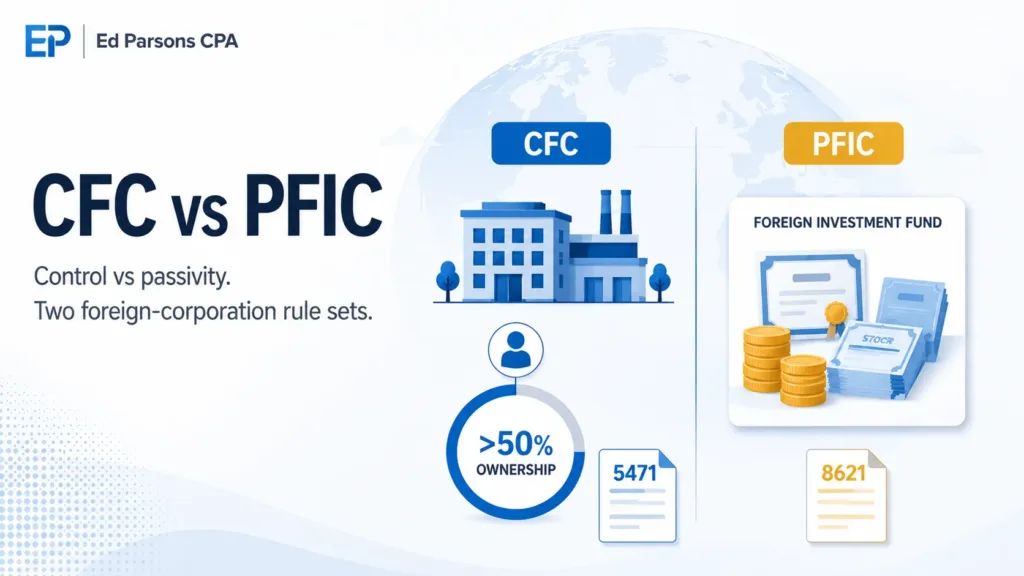
CFC vs PFIC comparison chart illustrating foreign investment fund rules and tax forms 5471 and 8621.

CFC vs. PFIC: How U.S. Tax Rules Differ for Foreign Corporations

A CFC and a PFIC are two separate sets of U.S. tax rules for foreign corporations. A CFC is about control: a foreign company more than 50% owned by U.S. shareholders who each hold at least 10%. A PFIC is about passivity: a foreign company that earns mostly passive income or holds mostly passive assets,

CFC vs PFIC: Controlled Foreign Corporation or Passive Foreign Investment Company? Read More »

Foreign mutual fund PFIC guide illustrating U.S. tax implications and reporting requirements.

Is Your Foreign Mutual Fund a PFIC? Edward Parsons, CPA 

By Edward Parsons, CPA (Massachusetts licence 26369) | IRS representation nationwide. Is your foreign mutual fund a PFIC? Almost certainly yes. Nearly every mutual fund organized outside the United States meets the IRS definition of a Passive Foreign Investment Company, because these funds hold mostly passive assets and earn mostly passive income. If you are

Is Your Foreign Mutual Fund a PFIC? Edward Parsons, CPA  Read More »

PFIC income test graphic illustrating 75% passive income threshold with dividends, interest, and rents.

How to Calculate the PFIC Income Test (the 75% Rule)?

By Edward Parsons, CPA  |  Ed Parsons CPA, Doral, Florida  |  Representing taxpayers nationwide  The PFIC income test asks one question: in a given tax year, is 75% or more of a foreign corporation’s gross income passive? Passive income means earnings like interest, dividends, rents, and royalties. If the answer is yes, the company meets

How to Calculate the PFIC Income Test (the 75% Rule)? Read More »

PFIC illustration: globe with foreign funds, ETF, and Form 8621.

What Is a PFIC? A Plain-English Guide for U.S. Investors With Foreign Funds

By Edward Parsons, CPA  |  Ed Parsons CPA, Doral, Florida  |  Representing taxpayers nationwide  A PFIC, or Passive Foreign Investment Company, is a foreign corporation that earns most of its money from passive sources or holds mostly passive assets. The most common examples are non-U.S. mutual funds and ETFs. If you are a U.S. taxpayer

What Is a PFIC? A Plain-English Guide for U.S. Investors With Foreign Funds Read More »

Forms 5471 and 8621 on a desk with a model of a foreign holding company, highlighting U.S. tax compliance for Controlled Foreign Corporations and Passive Foreign Investment Companies.

Unreported CFC or PFIC Investments? Streamlined Filing May Help Prevent Double Tax Problems.

A foreign corporation can be both a Controlled Foreign Corporation (CFC) and a Passive Foreign Investment Company (PFIC) at the same time. Without invoking the overlap exclusion under IRC Section 1297(d), a U.S. shareholder can face double taxation: PFIC excess distribution tax with interest charges on the same income that is also captured by CFC

Unreported CFC or PFIC Investments? Streamlined Filing May Help Prevent Double Tax Problems. Read More »

Yes, I can Meet In …
I am Available to Represent You in …