...

IRS help

Editorial CPA office desk scene showing foreign corporation cash and IRS Form 5471 Schedule I-1 connected by a glowing arrow representing phantom income and GILTI taxation.

Unreported GILTI Income? Streamlined Filing May Help Limit IRS Penalty Exposure

GILTI (Global Intangible Low-Taxed Income), renamed NCTI under the 2026 One Big Beautiful Bill Act, taxes U.S. shareholders on their share of a Controlled Foreign Corporation’s income above a deemed return on tangible assets, even when no distribution is made. Individual shareholders face the full ordinary income rate (up to 37%) on this phantom income.

Unreported GILTI Income? Streamlined Filing May Help Limit IRS Penalty Exposure Read More »

Editorial-style CPA office desk with IRS Form 5471 and five category document stacks illustrating foreign corporation reporting classifications and schedule burden.

Filed the Wrong Form 5471 Category? Streamlined Filing May Help Correct Past IRS Exposure.

Form 5471 has five filer categories under IRC Sections 6038 and 6046. Each category triggers a different combination of schedules, and filing under the wrong category leaves required schedules missing. The IRS treats an incomplete Form 5471 the same as an unfiled return: the same $10,000 initial penalty, the same $60,000 maximum per form per

Filed the Wrong Form 5471 Category? Streamlined Filing May Help Correct Past IRS Exposure. Read More »

Woman reading IRS streamlined filing rejection letter at dining table with tax documents and streamlined filing package folder

Rejected Streamlined Filing? Your IRS Exposure Can Escalate Quickly

A rejected streamlined filing eliminates the 5% penalty reduction permanently for the assets covered in the submission. There is no formal appeal process, the IRS retains every document submitted, and the standard penalty structure applies in full. Total exposure after rejection typically increases by five to ten times the streamlined penalty. Voluntary Disclosure or reasonable

Rejected Streamlined Filing? Your IRS Exposure Can Escalate Quickly Read More »

Man reviewing IRS streamlined filing rejection letter with Form 14654 tax documents and penalty calculator on office desk

Form 14654 Mistakes Can Increase Your Streamlined Filing Penalty Exposure

Form 14654 is the IRS certification used for the Streamlined Domestic Offshore Procedures. It combines three high-risk elements into one document: the non-willful certification narrative, the 5% penalty calculation, and the eligibility statement. A mistake in any of the three can lead the IRS to reject the entire submission, eliminate streamlined penalty relief permanently, and

Form 14654 Mistakes Can Increase Your Streamlined Filing Penalty Exposure Read More »

Editorial illustration showing IRS constructive ownership attribution rules involving family members, foreign corporations, Form 5471 exposure, and U.S. tax compliance

IRS Reclassified Your Foreign Company as a CFC? Streamlined Filing May Help Reduce the Damage.

If the IRS reclassifies your foreign company as a Controlled Foreign Corporation (CFC) under the constructive ownership rules of IRC Section 958, you owe Form 5471 for every year you were a U.S. shareholder. The penalty is $10,000 per form, per year, plus tax on undistributed GILTI and Subpart F income. The Streamlined Filing Compliance

IRS Reclassified Your Foreign Company as a CFC? Streamlined Filing May Help Reduce the Damage. Read More »

Professional hero banner for Domestic vs Foreign Streamlined Filing featuring CPA advisor in office library with tax compliance and offshore disclosure messaging.

Domestic vs Foreign Streamlined Filing: Choosing the Wrong Program Can Be Costly

The Streamlined Foreign Offshore Procedures (SFOP) carry a zero penalty, while the Streamlined Domestic Offshore Procedures (SDOP) impose a 5% penalty on the highest aggregate year-end balance of unreported foreign financial assets. Eligibility is based on a residency test. U.S. citizens and green card holders qualify for SFOP only if they spent at least 330

Domestic vs Foreign Streamlined Filing: Choosing the Wrong Program Can Be Costly Read More »

Ed Parsons CPA explaining foreign trust Form 3520-A penalties and streamlined filing options to help reduce IRS penalties for unfiled foreign trust forms

Form 3520-A Not Filed? The IRS Can Penalize 5% of Your Foreign Trust Value Every Year. Streamlined Filing May Help Avoid It.

If you are the U.S. owner of a foreign trust and Form 3520-A was never filed, the IRS penalty is 5% of the trust’s gross asset value at year-end. That responsibility falls on you personally, even if the foreign trustee was supposed to file. For a $400,000 trust, that is $20,000 per missed year. The

Form 3520-A Not Filed? The IRS Can Penalize 5% of Your Foreign Trust Value Every Year. Streamlined Filing May Help Avoid It. Read More »

stream lined filing may help reduce form 8938 penalties

Unreported Foreign Assets Over $200K? Streamlined Filing May Help Reduce Form 8938 Penalties.

Form 8938 is required for U.S. taxpayers with foreign financial assets above $50,000 (single filers in the U.S.). Missing the filing deadline triggers an immediate $10,000 IRS penalty. Every 30 days of non-compliance after an IRS notice adds another $10,000. The IRS Streamlined Filing Compliance Procedures can reduce or eliminate that penalty if your failure

Unreported Foreign Assets Over $200K? Streamlined Filing May Help Reduce Form 8938 Penalties. Read More »

Retrieve Your IRS Identity Protection PIN

How to Retrieve Your IRS Identity Protection PIN (IP PIN)?

To retrieve your IRS IP PIN, log in to your IRS Online Account at IRS.gov and check your Profile page. If you cannot access your account, call 800-908-4490 to have your IP PIN reissued. You can also file Form 15227 if your income is below $84,000 (individual) or visit a Taxpayer Assistance Center in person

How to Retrieve Your IRS Identity Protection PIN (IP PIN)? Read More »

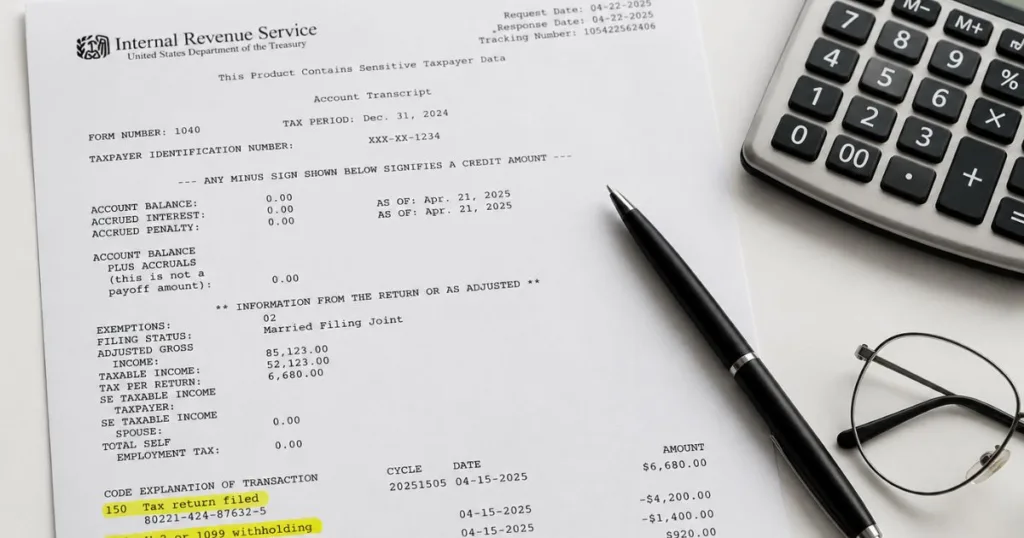
IRS account transcript with highlighted transaction codes 150 806 766 and 768 on a desk with calculator

What Do IRS Transcript Codes 150, 806, 766, and 768 Mean?

IRS transcript codes 150, 806, 766, and 768 are transaction codes on your IRS account transcript. Code 150 means your tax return was filed and your tax liability has been assessed. Code 806 shows your total withholding credits from W-2s and 1099s. Code 766 represents a tax credit applied to your account, such as the

What Do IRS Transcript Codes 150, 806, 766, and 768 Mean? Read More »

Yes, I can Meet In
I am Available to Represent You in