Skip to content

U.S. taxpayers with foreign business accounts must file FinCEN Form 114 (FBAR) when aggregate balances exceed the applicable reporting threshold, plus IRS Form 8938 under FATCA. Edward Parsons, CPA (based in Miami), guides clients through these reporting requirements, ensuring compliance and avoiding penalties that can be substantial per violation.
Foreign business accounts trigger significant U.S. reporting duties, including FinCEN Form 114 (FBAR) and Form 8938 under FATCA. Foreign corporations owned by U.S. taxpayers often require Form 5471, and undistributed income faces CFC and PFIC rules. Edward Parsons, CPA guides business owners nationwide through disclosure, catch-up filings, and penalty exposure tied to these obligations.
Key Takeaways
- Foreign corporations file Form 1120-F to report U.S.-source income and pay applicable federal taxes.
- The IRS treats foreign bank accounts differently than domestic accounts, requiring heightened scrutiny and reporting.
- U.S. citizens and green card holders face serious tax ramifications for holding offshore assets.
- Reporting requirements for taxpayers with foreign ties have become increasingly complicated in recent years.
Why Does the IRS Watch Foreign Business Accounts Closely?
Foreign business accounts receive a different level of scrutiny than domestic accounts. That gap drives most of the tax implications of foreign business accounts U.S. taxpayers eventually face. The Internal Revenue Service treats money parked overseas as a higher-risk category from the start. That treatment shapes reporting rules, audit selection, and penalty exposure for account holders across the country.
Concern about lost revenue sits behind much of this posture. Offshore accounts sit outside the IRS’s direct reach. The agency has made clear it prefers taxpayer assets to stay visible and reachable. Business owners with foreign subsidiaries, overseas payment processors, or international banking relationships fall squarely into this watch zone.
Why won’t some foreign banks accept U.S. account holders anymore?
Many foreign banks have grown wary of U.S. depositors in recent years. That reluctance traces directly to more aggressive enforcement from the IRS and the Department of Justice. Compliance costs and audit risk make U.S. clients less attractive to hold, even for long-established institutions.
What makes international reporting harder today than a decade ago?
Reporting obligations tied to cross-border business activity have grown more layered as the government works to capture revenue from international transactions. A single foreign entity can trigger overlapping filings, including:
- Entity-level information returns for foreign corporations or partnerships
- Account-level disclosures for foreign bank balances
- Income reporting tied to foreign-sourced earnings
Each layer adds complexity, and missing one piece can change a taxpayer’s entire compliance posture. Business owners with overseas accounts should treat each filing category as a separate obligation, not a single combined task.
Which Forms Report Your Foreign Business Accounts?
Several distinct forms come into play once a U.S. taxpayer opens or controls an account tied to a business entity abroad. The correct combination depends on account ownership and business structure. The tax implications of foreign business accounts start with a classification question, not a filing question: is the account holder a Foreign Person or a United States person for tax purposes? That determination shapes every form that follows.
Foreign corporations earning certain U.S.-source income face a separate obligation entirely. These entities must pay U.S. tax on that income and report it through Form 1120-F. Business owners who operate through a foreign corporate structure need to confirm whether that structure triggers this filing before assuming domestic rules apply.
For individual account holders, Schedule B carries real weight. Anyone holding a foreign account must complete Part III of Schedule B, disclosing the existence of the account even though the balance itself stays off that particular form.
Does Schedule B ask about the FBAR?
Yes. Schedule B requires taxpayers to state whether they have filed a Report of Foreign Bank. Financial Accounts, known as FinCEN Form 114 or the FBAR. Skipping this question, or answering it incorrectly, creates a mismatch that IRS systems can flag.
A quick reference helps organize these obligations:
Ed Parsons CPA works with business owners nationwide, sorting through which forms actually apply before deadlines close in.
How Does Business Structure Change Your Exposure?
Business structure determines which forms apply, which deadlines matter, and how much penalty risk a U.S. owner carries. A U.S. entrepreneur who forms a foreign corporation faces a different reporting burden than one who simply opens a brokerage account overseas. When a foreign individual or company acquires an interest in a U.S. business, it triggers specific U.S. tax obligations that require immediate review, not review after a filing deadline passes.
Tax implications of foreign business accounts depend on how the entity is organized and where it is domiciled — those two factors determine which forms apply and how detailed the reporting burden becomes.
Does it matter whether the entity is a corporation, fund, or account?
Yes. Classification drives everything downstream. A fund or entity organized outside the United States, such as an Irish-domiciled exchange-traded fund, gets treated as a passive foreign investment company (PFIC) for U.S. owners no matter what assets it holds. Domicile controls the outcome far more than the underlying investments do.
Which structures typically carry the highest reporting burden?
Certain entity types consistently draw more IRS attention:
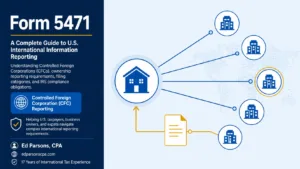
- Foreign corporations owned by U.S. shareholders, which often trigger Form 5471 reporting
- Foreign funds and ETFs, which frequently qualify as PFICs regardless of investment mix
- Foreign business bank accounts, which raise FBAR and FATCA obligations
- Cross-border acquisitions, where new ownership interests reshape the entire compliance picture
IRS compliance campaigns exist specifically to sharpen return selection and flag international noncompliance risk more efficiently. Owners of foreign structures sit squarely inside that focus. Reviewing entity classification early, before an acquisition closes or an account opens, keeps the filing position defensible instead of reactive.
What If You’ve Missed Prior-Year Filings?
Missed FBARs and unreported foreign accounts rarely lead to criminal exposure for non-willful taxpayers. American citizens, green card holders, and expatriates who discover unfiled international forms have a structured path back to compliance. The Streamlined Filing Compliance Procedures address exactly this situation. Understanding the mechanics of the program matters more than panicking over past mistakes.
Under this program, non-willful taxpayers file three years of amended or delinquent tax returns, six years of FBARs, and a signed certification explaining the circumstances behind the oversight. That certification carries weight. It documents the facts, the reasoning, and the corrective steps taken, and a poorly drafted version can undermine the whole filing.
The penalty outcome depends heavily on where the taxpayer resided during the years at issue:
- Foreign track: taxpayers who meet the residency requirements pay no penalty at all.
- Domestic track: taxpayers residing in the United States pay a 5 percent penalty, calculated on their highest foreign asset balances during the covered period.
The tax implications of foreign business accounts grow more serious the longer noncompliance continues, especially since foreign banks now report American account holders directly to the IRS under FATCA. Many business owners learn about a missed Form 5471 or a delinquent FBAR only after a notice arrives, well after their bank already flagged the account.
Does the IRS Already Know About My Foreign Account?
Likely yes. FATCA agreements require most foreign financial institutions to disclose American-owned accounts to the IRS automatically. That disclosure often happens before the account holder files anything, which is exactly why coming forward voluntarily remains the stronger position.
Where Should You Turn for Guidance Next?
Guidance starts with a clear diagnosis, not a generic checklist. Edward Parsons, CPA works directly with U.S. taxpayers across the country — from small business owners in Ohio to expatriates managing accounts in the Pacific Northwest. Who hold foreign business accounts and foreign entities. That nationwide reach matters, because the rules governing tax implications of foreign business accounts apply the same way whether the taxpayer lives in Texas, California, or overseas.
The first real step is classification, not paperwork. Determining whether a business or its owner qualifies as a foreign person or a United States person sets the direction for every form that follows. Skip this step, and the wrong filings can pile up fast.
What if past filings were missed or incomplete?
Missed filings do not have to mean permanent exposure. For taxpayers whose noncompliance was non-willful, the streamlined filing procedures offer a defined path back to good standing, rather than leaving accounts flagged indefinitely.
How does someone know which path applies to their situation?
The right path depends on facts: entity structure, account history, and prior filing conduct. A structured review typically covers:
- Entity classification (foreign vs. U.S. person status)
- Prior-year filing history and gaps
- Applicable forms tied to the business account or entity
- Whether streamlined procedures fit the taxpayer’s conduct
Working through these points in order, rather than guessing, keeps the filing position defensible.
Facts
- Edward Parsons, CPA is located in Doral, FL, US.
- Edward Parsons, CPA has 1 employees.
Foreign business accounts demand systematic attention, not afterthought compliance. The forms stack up FBARs, FATCA disclosures, CFC reporting, foreign tax credits and each one carries real consequences for missed or incomplete filing. The core issue remains unchanged: the IRS expects U.S. taxpayers to report most worldwide income and foreign financial accounts, but specific rules may apply. Getting ahead of these obligations now, with clear documentation and accurate filings, protects you far better than managing penalties and enforcement later. Start by identifying what you hold and what you owe.